
 Written byAnju Mobin, B.ScNutritionist · B.Sc. Clinical Nutrition & DieteticsLast updatedProducts compared6 picks from 16 productsHow we review →
We may earn a commission when you buy through our links, at no extra cost to you. As an Amazon Associate we earn from qualifying purchases. How we make money
At a Glance
- Best Overall Thorne Ashwagandha – 120 mg of Shoden extract, the exact daily dose used in a sleep trial, NSF Contents Certified.Review ↓
- Best Value Nutricost KSM-66 Ashwagandha – 600 mg of KSM-66 in one capsule, the dose used in stress trials, at the lowest cost per serving on our list.Review ↓
- Best Clean-Label KSM-66 Pure Encapsulations Ashwagandha – 500 mg of KSM-66 with only cellulose added.Review ↓
- Best Clinically Tested Product Gaia Herbs Ashwagandha Root – the same product used in a 30-day stress trial in students.Review ↓
- Best Higher-Dose KSM-66 Physician’s Choice KSM-66 Ashwagandha – 1,000 mg of organic KSM-66 per 2 capsules.Review ↓
- Best Whole-Root Organic Himalaya Organic Ashwagandha – USDA Organic root powder and extract in one caplet a day.Review ↓
The Short Answer: The best ashwagandha supplement is a standardized extract at the dose used in trials: about 600 mg a day of a root extract such as KSM-66, or 120 mg a day of the more concentrated Shoden extract12. Thorne Ashwagandha is our top pick: 120 mg of Shoden in one capsule, NSF Contents Certified and with a short ingredient list.
On this page
- Do You Actually Need an Ashwagandha Supplement?
- Find Your Match
- KSM-66 vs. Shoden vs. Whole Root
- Ashwagandha Supplements Compared
- The 6 Best Ashwagandha Supplements, Reviewed
- Products We Didn’t Recommend
- Evidence Scorecard
- How to Take Ashwagandha for Best Results
- What to Expect and When
- Safety, Side Effects & Drug Interactions
- How to Choose an Ashwagandha Supplement
- Frequently Asked Questions
- Final Verdict
Choose KSM-66 if you want the most-studied root extract, and Shoden if sleep is your main goal. Use it for up to about 3 months at a time, since longer-term safety hasn’t been studied1.
We compared 16 ashwagandha labels on extract type, dose against trials, withanolide content, testing, other ingredients and value, and checked sellers and listing details. Every product is ranked by its BFN Score, a relative score within this guide. See our review process for how we score.
Do You Actually Need an Ashwagandha Supplement?
Most people don’t. Ashwagandha is not a nutrient, so there is no deficiency to correct. It may help if stress, anxiety or poor sleep are affecting your daily life and you want to try an herbal option alongside sleep, exercise and other proven habits.
In a review of 7 trials with 491 adults, extracts lowered perceived stress and anxiety over 6 to 8 weeks, with larger benefits at 500 to 600 mg a day1. A meta-analysis of 5 trials found a small but significant improvement in sleep, stronger at 600 mg a day or more and after at least 8 weeks2.
Who Should Skip It
- People who are pregnant, breastfeeding or trying to conceive1.
- People with thyroid conditions or who take thyroid medicine: ashwagandha can raise thyroid hormone levels1.
- People with liver disease or a history of liver problems3.
- Men with hormone-sensitive prostate cancer1.
- People taking sedatives, immunosuppressants, or medicines for diabetes or blood pressure, unless their doctor approves1.
Nutritionist tip: Denmark banned ashwagandha in 2023 after a safety review1, so if you live outside the U.S., check your country’s rules.
Find Your Match
| If you… | Consider | Why |
|---|---|---|
| Want a well-tested, low-dose option | Thorne Ashwagandha | NSF Contents Certified, 120 mg Shoden |
| Mainly want better sleep | Thorne Ashwagandha | Matches the Shoden sleep-trial dose1 |
| Want the trial dose for stress at low cost | Nutricost KSM-66 Ashwagandha | 600 mg in one capsule |
| Want KSM-66 with no other actives | Pure Encapsulations Ashwagandha | Only cellulose added |
| Want a product that was itself tested | Gaia Herbs Ashwagandha Root | Used in a 30-day trial1 |
| Want a higher KSM-66 dose | Physician’s Choice KSM-66 | 1,000 mg per serving |
| Prefer certified organic whole root | Himalaya Organic Ashwagandha | USDA Organic, 1 caplet |
| Prefer a chewable | Our ashwagandha gummies guide | Compared gummy formulas |
KSM-66 vs. Shoden vs. Whole Root
| Type | Plant part | Typical trial dose | Studied for | Our pick |
|---|---|---|---|---|
| KSM-66 | Root | 600 mg a day | Stress, anxiety, sleep1 | Nutricost, Pure Encapsulations |
| Shoden | Root and leaf | 120 mg a day | Sleep, stress1 | Thorne |
| Gaia Herbs root blend | Root | 350 mg twice a day | Stress1 | Gaia Herbs |
| Whole-root powder | Root | Not well studied at label doses | Traditional use | Himalaya |
Withanolides are the compounds most often used to standardize ashwagandha. Higher percentages don’t automatically mean better results. See our KSM-66 vs. Sensoril vs. regular ashwagandha and what are withanolides guides.
Ashwagandha Supplements Compared
Scroll sideways to see every column →
| # | Product | Extract | Dose per Serving | Withanolides | Servings | Daily Pills | Purity Testing | Additives | Diet | Cost |
|---|---|---|---|---|---|---|---|---|---|---|
| 1 | Thorne Ashwagandha | Shoden (root, leaf) | 120 mg | 35% glycosides (about 42 mg) | 30 | 1 capsule | NSF Contents Certified | Clean | Vegetarian capsule | $$$ |
| 2 | Nutricost KSM-66 | KSM-66 (root) | 600 mg | Min. 5% (30 mg) | 60 | 1 capsule | Not stated | Note | Gluten-free | $$$ |
| 3 | Pure Encapsulations | KSM-66 (root) | 500 mg | Not stated on listing | 60 | 1 capsule | Not stated | Clean | Vegetarian capsule | $$$ |
| 4 | Gaia Herbs | Root and root extract | 700 mg (2 capsules) | 5 mg | 30 | 2 capsules | Not stated | Clean | Vegan | $$$ |
| 5 | Physician’s Choice | KSM-66 (root) | 1,000 mg (2 capsules) | 5% (about 50 mg) | 30 | 2 capsules | Not stated | Note | Vegan | $$$ |
| 6 | Himalaya Organic | Root powder and extracts | 670 mg | About 3 mg | 120 | 1 caplet | Not stated | Clean | USDA Organic | $$$ |
Cost tiers per daily serving: $ under $0.30 · $$ $0.30–$0.70 · $$$ over $0.70 (checked November 2026). Ashwagandha has no Daily Value or established upper limit.
The 6 Best Ashwagandha Supplements, Reviewed
#1Best Overall
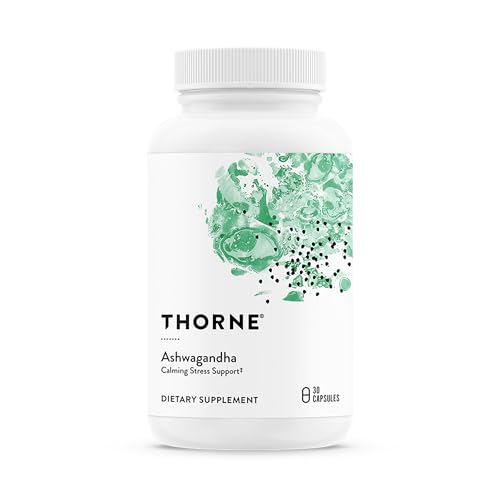
1. Thorne Ashwagandha
BFN Score9.6/10
$$$Premium30 servings1 capsule per serving
Strongest atDose accuracyWeakest atValue & practicality
Thorne uses 120 mg of Shoden, a root-and-leaf extract standardized to 35% withanolide glycosides, in one capsule a day. The bottle carries the NSF Contents Certified mark.
Label Reality Check
- Active ingredient + form
- Shoden ashwagandha extract (root, leaf)
- Dose per serving
- 120 mg (1 capsule); about 42 mg withanolide glycosides
- Dose vs. research
- Matches the 120 mg daily dose in a 6-week sleep trial1
- % DV / Upper Limit
- No DV or UL
- Purity testing
- NSF Contents Certified
- Other ingredients
- microcrystalline cellulose, hypromellose capsule, ascorbyl palmitate
- Additives
- Clean
- Allergens & diet
- vegetarian capsule
- Safety flags
- Pregnancy and trying to conceive; thyroid conditions; liver disease; sedatives
Clinical Relevance
In a 6-week trial of 150 adults, 120 mg a day of Shoden improved sleep quality in 72% of users versus 29% on placebo1. Shoden has also been studied for stress, though in fewer trials than KSM-66.
Strengths
- Trial-matched dose in one capsule
- Independent NSF certification
- Short ingredient list
Limitations
- Highest cost per serving tier
- Only 30 capsules per bottle
- Fewer trials than KSM-66
Practical Details
Take one capsule a day. Many people take it in the evening if sleep is the goal.
Best For / Not For
Best foradults who want a tested, low-dose extract, especially for sleep.
Not forbudget buyers or anyone pregnant or trying to conceive.
Buyer Experience
Buyers say it helps lower stress and anxiety and improves their sleep. Many trust the brand’s quality.
Side effects are mentioned by some buyers.
vs. Nutricost KSM-66 Ashwagandha
Choose Thorne for a sleep-focused extract with NSF certification and no black pepper extract. Choose Nutricost for the 600 mg KSM-66 trial dose at a much lower cost.
Nutritionist’s Note
The label says not to use it if you are pregnant, nursing or trying to conceive.
Verdict: The best-tested ashwagandha on our list, at the exact dose used in a sleep trial.
#2Best Value
2. Nutricost KSM-66 Ashwagandha

BFN Score9.2/10
$$$Budget60 servings1 capsule per serving
Strongest atValue & practicalityWeakest atQuality & trust
Nutricost provides 600 mg of organic KSM-66 root extract, standardized to at least 5% withanolides, in a single capsule. It costs the least per serving on our list.
Label Reality Check
- Active ingredient + form
- organic KSM-66 ashwagandha root extract
- Dose per serving
- 600 mg (1 capsule); min. 30 mg withanolides
- % DV / Upper Limit
- No DV or UL
- Purity testing
- Not stated (brand says third-party tested, lab not named)
- Other ingredients
- hypromellose capsule, organic flow agent blend, silica, magnesium stearate; 5 mg BioPerine black pepper extract on the Supplement Facts image
- Additives
- Note (black pepper extract)
- Allergens & diet
- gluten-free, non-GMO
- Safety flags
- Pregnancy and breastfeeding; thyroid conditions; liver disease; medicines affected by piperine
Clinical Relevance
600 mg a day of KSM-66 is the dose used in most stress and sleep trials of this extract12. The small amount of black pepper extract isn’t needed for it to work.
Strengths
- Trial dose in one capsule
- Lowest cost per serving
- Withanolide content stated
Limitations
- Contains black pepper extract
- No independent certifier named
- Listing text and label image differ
Practical Details
Take one capsule a day with 8 to 12 oz of water. Check the bottle you receive, since the listing text and label image don’t match.
Best For / Not For
Best forbudget buyers who want the trial dose of KSM-66.
Not forpeople who want to avoid black pepper extract.
Buyer Experience
Buyers say it helps with stress and sleep, is easy to swallow and has no aftertaste. Many see it as good value.
Repeated complaints are few in buyer feedback.
vs. Pure Encapsulations Ashwagandha
Choose Nutricost for the full 600 mg at a lower cost. Choose Pure Encapsulations for a capsule with nothing but KSM-66 and cellulose.
Nutritionist’s Note
If you take medicines with a narrow dosing range, ask your pharmacist about piperine before choosing a product that contains it.
Verdict: The trial dose of KSM-66 at the lowest cost per serving.
#3Best Clean-Label KSM-66
3. Pure Encapsulations Ashwagandha

BFN Score9.2/10
$$$Mid-range60 servings1 capsule per serving
Strongest atPurity & additivesWeakest atQuality & trust
Pure Encapsulations puts 500 mg of KSM-66 root extract in each capsule, with only cellulose added. There is no black pepper or other active ingredient.
Label Reality Check
- Active ingredient + form
- KSM-66 ashwagandha root extract
- Dose per serving
- 500 mg (1 capsule)
- Dose vs. research
- Within the 500–600 mg range linked to larger stress benefits1
- % DV / Upper Limit
- No DV or UL
- Purity testing
- Not stated
- Other ingredients
- cellulose, vegetarian capsule (cellulose, water)
- Additives
- Clean
- Allergens & diet
- vegetarian capsule
- Safety flags
- Pregnancy and breastfeeding; thyroid conditions; liver disease; sedatives
Clinical Relevance
KSM-66 is the most studied ashwagandha root extract, and 500 to 600 mg a day is where stress trials saw the clearest benefit1.
Strengths
- No added actives
- Trial-range KSM-66 dose
- One capsule a day
Limitations
- No independent certifier named
- Withanolide content not stated on the listing
- Slightly below the 600 mg dose
Practical Details
Take one capsule a day, with or between meals.
Best For / Not For
Best forpeople who want plain KSM-66 with nothing else added.
Not forpeople who want third-party certification.
Buyer Experience
Buyers say it helps with sleep and stress and praise its clean ingredients and trusted brand.
Repeated complaints are few in buyer feedback.
vs. Physician’s Choice KSM-66 Ashwagandha
Choose Pure Encapsulations for a trial-range dose in one capsule with no black pepper extract. Choose Physician’s Choice for a higher dose of organic KSM-66 with stated withanolides.
Nutritionist’s Note
If you take thyroid medicine, ask your doctor to recheck your levels if you start ashwagandha1.
Verdict: The cleanest KSM-66 on our list, at a trial-range dose.
#4Best Clinically Tested Product
4. Gaia Herbs Ashwagandha Root

BFN Score9.1/10
$$$Premium30 servings2 capsules per serving
Strongest atEvidence fitWeakest atValue & practicality
Gaia Herbs blends organic ashwagandha root with a root extract in a liquid-filled vegan capsule: 350 mg and 2.5 mg of withanolides each. This product, at 1 capsule twice a day, was used in a 30-day trial in students1.
Label Reality Check
- Active ingredient + form
- organic ashwagandha root and root extract blend
- Dose per serving
- 700 mg (2 capsules); 5 mg withanolides
- Dose vs. research
- Matches the dose used in its own 30-day trial1
- % DV / Upper Limit
- No DV or UL
- Purity testing
- Not stated
- Other ingredients
- vegetable glycerin, water, vegan capsule (hypromellose)
- Additives
- Clean
- Allergens & diet
- vegan, gluten-free, dairy-free, soy-free
- Safety flags
- Pregnancy and breastfeeding; thyroid conditions; liver disease; sedatives
Clinical Relevance
Few supplements have been tested as the finished product. In a 30-day trial of 60 students, this capsule taken twice a day improved overall stress scores1.
Strengths
- Finished product was trial-tested
- Organic root, vegan capsule
- No fillers
Limitations
- Low withanolide content
- 2 capsules a day
- Higher cost per serving
Practical Details
Take one capsule twice a day. The label notes that benefits build over time.
Best For / Not For
Best forpeople who want a whole-root product with its own trial.
Not forpeople who want a high-potency extract.
Buyer Experience
Buyers say it helps with stress, sleep and mood, and they trust the brand. Many find the capsules easy to swallow.
Repeated complaints are few in buyer feedback.
vs. Himalaya Organic Ashwagandha
Choose Gaia Herbs for a product backed by its own trial. Choose Himalaya for one caplet a day at a lower cost.
Nutritionist’s Note
The trial ran only 30 days in healthy students, so results may differ for older adults or people with anxiety disorders.
Verdict: A gentle organic root product with its own trial behind it.
#5Best Higher-Dose KSM-66
5. Physician’s Choice KSM-66 Ashwagandha

BFN Score8.2/10
$$$Premium30 servings2 capsules per serving
Strongest atEvidence fitWeakest atDose accuracy
Physician’s Choice provides 1,000 mg of organic KSM-66, standardized to 5% withanolides, plus 15 mg of organic black pepper extract per 2 capsules.
Label Reality Check
- Active ingredient + form
- organic KSM-66 ashwagandha root extract
- Dose per serving
- 1,000 mg (2 capsules); about 50 mg withanolides
- Dose vs. research
- Above the 600 mg dose used in most KSM-66 trials1
- % DV / Upper Limit
- No DV or UL
- Purity testing
- Not stated (brand says third-party tested, lab not named)
- Other ingredients
- vegetable cellulose capsule, 15 mg organic black pepper extract
- Additives
- Note (black pepper extract)
- Allergens & diet
- vegan
- Safety flags
- Pregnancy and breastfeeding; thyroid conditions; liver disease; medicines affected by piperine
Clinical Relevance
KSM-66 is well studied, but 1,000 mg a day is above the dose most trials used. Liver injury reports have involved doses from 450 to 1,350 mg a day1.
Strengths
- Organic KSM-66
- Withanolide content stated
- Flexible: 1 capsule gives 500 mg
Limitations
- Full serving above trial dose
- Contains black pepper extract
- Highest cost per serving
Practical Details
The label directs 2 capsules once a day. One capsule (500 mg) keeps you in the trial range.
Best For / Not For
Best forpeople who want a higher-strength KSM-66 and can split the dose.
Not forpeople taking medicines affected by piperine.
Buyer Experience
Buyers say it reduces stress, improves sleep quality and helps their mental clarity and focus.
Repeated complaints are few in buyer feedback.
vs. Nutricost KSM-66 Ashwagandha
Choose Physician’s Choice for a higher dose of organic KSM-66. Choose Nutricost for the trial dose in one capsule at a lower cost.
Nutritionist’s Note
More isn’t better with ashwagandha; start with one capsule and stop if you notice dark urine, yellow skin or unusual tiredness.
Verdict: A strong organic KSM-66 that most people should take at half the label dose.
#6Best Whole-Root Organic
6. Himalaya Organic Ashwagandha

BFN Score8.2/10
$$$Mid-range120 servings1 caplet per serving
Strongest atPurity & additivesWeakest atEvidence fit
Himalaya combines 380 mg of organic root powder, 280 mg of organic root extract and 10 mg of a CO2 extract in one caplet. Together they supply about 3 mg of withanolides.
Label Reality Check
- Active ingredient + form
- organic ashwagandha root powder, root extract and CO2 extract
- Dose per serving
- 670 mg (1 caplet); about 3 mg withanolides
- Dose vs. research
- Well below the withanolide content of trial extracts1
- % DV / Upper Limit
- No DV or UL
- Purity testing
- Not stated
- Other ingredients
- none listed
- Additives
- Clean
- Allergens & diet
- USDA Organic
- Safety flags
- Pregnancy and breastfeeding; thyroid conditions; liver disease; sedatives
Clinical Relevance
Whole-root powder is the traditional form, but most trials used concentrated extracts. This caplet supplies much less of the standardized compounds than KSM-66 or Shoden.
Strengths
- USDA Organic
- No additives listed
- One caplet a day
Limitations
- Low withanolide content
- Not matched to a trial dose
- No independent certifier named
Practical Details
Take one caplet a day before food, as the label directs.
Best For / Not For
Best forpeople who prefer certified organic whole root.
Not forpeople who want a trial-matched extract.
Buyer Experience
Buyers say it helps with stress and anxiety and that they wake up with more energy.
Repeated complaints are few in buyer feedback.
vs. Gaia Herbs Ashwagandha Root
Choose Himalaya for one caplet a day at a lower cost. Choose Gaia Herbs for a whole-root product that was tested in a trial.
Nutritionist’s Note
Whole-root products are milder. If you notice no change after 8 weeks, a standardized extract may be a better fit.
Verdict: A clean, certified organic whole-root option.
Products We Didn’t Recommend
Transparent Labs KSM-66 and Legion KSM-66. Both use 600 mg of KSM-66, but each listing had very few buyer reviews when we checked.
Double Wood Ashwagandha 20:1. The label lists a 20:1 extract but doesn’t state withanolide content.
Natural Factors KSM-66. At the label’s 2 capsules a day, a 30-capsule bottle lasts only 15 days.
XYMOGEN Ashwagandha 35. Uses the same Shoden extract as our top pick, with few buyer reviews.
PrimaForce KSM-66. Adds BioPerine and had very few buyer reviews.
Evidence Scorecard
| Ingredient / Form | What it’s studied for | Evidence level | Notes |
|---|---|---|---|
| Ashwagandha extracts, 240–1,250 mg a day | Stress, anxiety | Moderate | 7 trials, 491 adults, 6–8 weeks; larger benefit at 500–600 mg1 |
| Ashwagandha extracts | Sleep | Moderate | 5 trials: small benefit, larger at 600 mg+ and 8 weeks+2 |
| Shoden, 120 mg a day | Sleep quality | Limited | One 6-week trial in 150 adults1 |
| Gaia Herbs root, 350 mg twice a day | Stress | Limited | One 30-day trial in 60 students1 |
| Long-term use (over 3 months) | Safety | Unknown | Not studied1 |
Ashwagandha supplements are not treatments for anxiety disorders or insomnia and should not replace care from your doctor.
How to Take Ashwagandha for Best Results
| Extract | Dose used in trials | How long |
|---|---|---|
| KSM-66 root extract | 600 mg a day | 8 weeks12 |
| Shoden root and leaf extract | 120 mg a day | 6 weeks1 |
| Gaia Herbs root blend | 700 mg a day (2 × 350 mg) | 30 days1 |
Ashwagandha has no RDA or established upper limit.
- Match the dose to the extract, not to the biggest number on the label.
- Give it 6 to 8 weeks, the length of most trials1.
- Take a break after about 3 months: longer-term safety isn’t known1.
- Take it with food if it upsets your stomach.
For more detail, see our guides to the best time to take ashwagandha, ashwagandha for sleep, ashwagandha for anxiety and KSM-66 ashwagandha supplements.
What to Expect and When
Most trials measured changes after 6 to 8 weeks of daily use1. Sleep benefits were larger after at least 8 weeks2.
If you notice no change after 8 weeks, ashwagandha may not be right for you. Talk to your doctor if stress, anxiety or sleep problems continue.
Safety, Side Effects & Drug Interactions
Ashwagandha is usually well tolerated for up to about 3 months. The most common side effects are stomach upset, loose stools, nausea and drowsiness1. Rare cases of liver injury have been reported, most improving after people stopped taking it13.
| Medication or condition | Possible interaction | What to do |
|---|---|---|
| Thyroid medicine or thyroid conditions | Can raise thyroid hormone levels1 | Avoid unless your doctor approves |
| Sedatives and sleep medicines | Added drowsiness1 | Ask your doctor first |
| Diabetes medicines | May add to blood sugar lowering1 | Monitor blood sugar |
| Blood pressure medicines | May add to blood pressure lowering1 | Monitor readings |
| Immunosuppressants | Possible interaction1 | Avoid unless your doctor approves |
| Liver disease or liver symptoms | Rare liver injury reports3 | Stop and see a doctor if you notice dark urine or yellow skin |
| Pregnancy and breastfeeding | Safety not established1 | Avoid |
How to Choose an Ashwagandha Supplement
Form and Absorption
Pick a named, standardized extract such as KSM-66 or Shoden, since these are what trials tested. Whole-root powders are milder and less studied.
Dose and % DV
Match the dose to the extract: about 600 mg for KSM-66 or 120 mg for Shoden. Ashwagandha has no Daily Value.
Purity Testing
Look for NSF, USP or another named certifier. Herbal products can vary, and “third-party tested” without a lab name tells you little.
Additives and Allergens
Most capsules use only cellulose or a flow agent. Check for black pepper extract if you take medicines that interact with it.
Pill Burden and Format
One capsule a day is easiest. For gummies, see our ashwagandha gummies guide.
Cost per Effective Dose
Compare cost per trial-matched daily dose, not per bottle.
Label Red Flags
- No extract name or withanolide content
- Doses well above 1,000 mg a day
- Proprietary blends with many stress herbs
- Claims to treat anxiety, depression or insomnia
Important: These supplements are not intended to diagnose, treat, cure, or prevent any disease. Results vary by individual. If you have a health condition or take medications, check with your doctor before adding any new supplement to your routine.
Frequently Asked Questions
What is the best ashwagandha supplement?
A standardized extract at the dose used in trials. Thorne Ashwagandha is our top pick for its NSF certification and trial-matched Shoden dose; Nutricost KSM-66 is the budget pick.
Is KSM-66 better than other ashwagandha?
KSM-66 is the most studied root extract, but Shoden has also been tested at a lower dose1. Both are reasonable choices; whole-root powders have less evidence.
How much ashwagandha should I take a day?
Follow the extract’s trial dose: about 600 mg a day of KSM-66 or 120 mg of Shoden1. More is not better.
How long does ashwagandha take to work?
Is it safe to take ashwagandha every day?
For most healthy adults, daily use for up to about 3 months appears safe1. Avoid it if you are pregnant or breastfeeding or have thyroid or liver problems, and stop if you notice dark urine or yellow skin. See our guide on daily ashwagandha safety.
Final Verdict
Thorne Ashwagandha is the best ashwagandha supplement for most people: 120 mg of Shoden, the dose used in a sleep trial, with NSF Contents Certified status.
For the trial dose at the lowest cost, choose Nutricost KSM-66 Ashwagandha. For plain KSM-66 with nothing else added, choose Pure Encapsulations Ashwagandha.
Use ashwagandha for up to about 3 months at a time, and skip it if you are pregnant or have thyroid or liver problems.
Sources & History
References
- Ashwagandha: Is It Helpful for Stress, Anxiety, or Sleep? Fact Sheet for Health Professionals — NIH Office of Dietary Supplements
- Effect of Ashwagandha (Withania somnifera) Extract on Sleep: A Systematic Review and Meta-Analysis — PLOS One, 2021
- Ashwagandha — LiverTox: Clinical and Research Information on Drug-Induced Liver Injury, NIH
Update history
- Rebuilt with BFN Score v3: compared 16 ashwagandha labels and ranked six products by extract type, dose against trials, withanolide content, testing, other ingredients and value; added a KSM-66 vs. Shoden vs. whole-root table, stress and sleep evidence, liver and thyroid safety notes and a drug-interaction table.
