
- Our Top Picks for Red Yeast Rice Supplements
- Red Yeast Rice Supplements Compared
- 1. Nature’s Craft Red Yeast Rice + CoQ10 — Best Overall
- 2. ForestLeaf Red Yeast Rice 1215 mg + CoQ10 — Best Multi-Ingredient Formula
- 3. Designs for Health Red Yeast Rice — Best Practitioner-Grade
- 4. Nutricost Red Yeast Rice 1200 mg — Best Budget
- 5. Zazzee Organic Red Yeast Rice + CoQ10 — Best Citrinin-Free Extract
- 6. aSquared Nutrition Red Yeast Rice 1800 mg — Best High-Dose
- 7. NaturesPlus Herbal Actives Red Yeast Rice — Best for Flexible Dosing
- 8. NatureBell Red Yeast Rice with CoQ10 — Best Small Capsule
- Evidence-Based Ingredients
- What Are Red Yeast Rice Supplements?
- Common Signs You May Need Red Yeast Rice Support
- Key Ingredients to Look For
- How to Choose
- Who May Benefit
- Safety and Side Effects
- What Results Can You Expect?
- Lifestyle Tips
- FAQ
- Final Thoughts
Your lab results came back with LDL cholesterol a little higher than your doctor would like, and you would rather start with diet, exercise, and possibly a supplement. Red yeast rice is usually the first name that comes up.
It has a real clinical track record. Red yeast rice naturally contains monacolin K, a compound chemically identical to the active ingredient in lovastatin, and several randomized trials have shown it can help maintain healthy LDL levels.
The catch is quality. Monacolin content varies widely between brands, some products have tested positive for a kidney toxin called citrinin, and few labels tell you what is actually inside.
This guide compares eight popular options on dose, formula, contamination testing, and price per serving, so you can choose one that fits your needs and discuss it with your doctor.
Our Top Picks for Red Yeast Rice Supplements
Best Overall: Nature’s Craft Red Yeast Rice + CoQ10 — 1,200 mg red yeast rice plus 100 mg CoQ10, backed by 8,000+ ratings.
Best Multi-Ingredient Formula: ForestLeaf Red Yeast Rice 1215 mg + CoQ10 — Citrinin-free red yeast rice with CoQ10, alpha lipoic acid, and flaxseed.
Best Practitioner-Grade: Designs for Health Red Yeast Rice — Organic, U.S.-grown, and batch-tested for citrinin and monacolin content.
Best Budget: Nutricost Red Yeast Rice 1200 mg — The standard 1,200 mg daily dose for about $0.20 per serving.
Best Citrinin-Free Extract: Zazzee Organic Red Yeast Rice + CoQ10 — Organic extract screened below 1 ppm citrinin by an accredited lab.
Best High-Dose: aSquared Nutrition Red Yeast Rice 1800 mg — 1,800 mg per serving in a simple, single-ingredient vegan capsule.
Best for Flexible Dosing: NaturesPlus Herbal Actives Red Yeast Rice — Standardized 600 mg capsules make gradual dose adjustments easy.
Best Small Capsule: NatureBell Red Yeast Rice with CoQ10 — Small, tasteless capsules with 100 mg CoQ10 per serving.
Red Yeast Rice Supplements Compared
| Rank | Product | Form | Price/Serving | Best For |
|---|---|---|---|---|
| 1 | Nature’s Craft Red Yeast Rice + CoQ10 | Capsule (powder + CoQ10) | $0.38 | Adults who want red yeast rice and CoQ10 in one daily capsule |
| 2 | ForestLeaf Red Yeast Rice 1215 mg + CoQ10 | Capsule (4-ingredient blend) | $0.73 | People who prefer one comprehensive heart-support routine |
| 3 | Designs for Health Red Yeast Rice | Capsule (organic powder) | $0.62 | Buyers who prioritize sourcing and batch-testing transparency |
| 4 | Nutricost Red Yeast Rice 1200 mg | Capsule (powder) | $0.20 | Budget shoppers who prefer to choose their own CoQ10 |
| 5 | Zazzee Organic Red Yeast Rice + CoQ10 | Vegan capsule (20:1 extract + CoQ10) | $0.33 | Vegans most concerned about citrinin contamination |
| 6 | aSquared Nutrition Red Yeast Rice 1800 mg | Capsule (powder) | $0.50 | Adults whose provider recommends more than 1,200 mg daily |
| 7 | NaturesPlus Herbal Actives Red Yeast Rice | Capsule (standardized extract) | $0.40 (600 mg) | Beginners who want to start low and increase gradually |
| 8 | NatureBell Red Yeast Rice with CoQ10 | Capsule (4:1 extract + CoQ10) | $0.21 | People who have trouble swallowing large pills |
1. Nature’s Craft Red Yeast Rice + CoQ10 — Best Overall
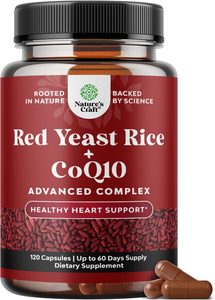
Price: $22.99 (as of Sep 29, 2026)
Nature’s Craft pairs a full 1,200 mg dose of red yeast rice with 100 mg of CoQ10 per serving, tying for the highest CoQ10 amount in this guide.
Key Specs
- Active ingredient + form: Red yeast rice (Monascus purpureus) powder + CoQ10 (ubiquinone)
- Dose per serving: 1,200 mg red yeast rice, 100 mg CoQ10 (2 capsules)
- Certifications: Made in a GMP-compliant facility; ISO 17025 lab tested
- Third-party tested: Yes (per brand)
- Citrinin-free claim: Not stated on label
- Servings per container: 60
- Price per serving: $0.38 (calculated manually, price as of Sep 29, 2026)
Key Benefits
Combining red yeast rice and CoQ10 in one capsule makes sense because monacolin K works on the same liver pathway the body uses to make its own CoQ10. The 1,200 mg daily dose sits within the 1,200–2,400 mg range used in most clinical trials.
With nearly 8,500 Amazon ratings, it is also the most widely reviewed product on this list, which gives a clearer picture of real-world tolerance.
Key Ingredients
- Red Yeast Rice (Monascus purpureus powder, 1,200 mg): Contains naturally occurring monacolins that inhibit HMG-CoA reductase, the liver enzyme that controls cholesterol production.
- Coenzyme Q10 (ubiquinone, 100 mg): Supports mitochondrial energy production and helps offset CoQ10 that may decline when HMG-CoA reductase is inhibited.
Pros
- 100 mg CoQ10 per serving, above the 60–80 mg found in several competing combination formulas
- Fair cost at $0.38 per serving for a two-ingredient formula
- Label allows 2 to 4 capsules daily, so the dose can be adjusted with a doctor’s guidance
Cons
- No citrinin-free claim or monacolin content listed on the label
- Side effect reviews are nearly split, with stomach pain and headaches mentioned most often
Best Suited For
Adults who already plan to take CoQ10 alongside red yeast rice and want both in a single, moderately priced capsule.
Usage Recommendations
Take 2 capsules daily with a meal. The label allows up to 4 capsules daily, but only increase the dose under a healthcare provider’s supervision.
Customer Feedback
Buyers most often mention the convenience of getting red yeast rice and CoQ10 in one product, and several say it let them drop a separate CoQ10 bottle. Many report better cholesterol numbers at their next lab check, and a few say their doctor encouraged them to continue. The capsules are generally described as easy to swallow with no aftertaste, and value for money earns consistently positive comments.
Side effect feedback is almost evenly divided. Some users notice nothing, while others describe stomach pain, headaches, or statin-like muscle aches that led them to stop. Opinions on capsule size are also mixed, so people who struggle with larger pills may want to try the smaller bottle first.
Summary: Nature’s Craft earns Best Overall for combining a clinically relevant red yeast rice dose with generous CoQ10 at a fair price, backed by the largest review base here.
2. ForestLeaf Red Yeast Rice 1215 mg + CoQ10 — Best Multi-Ingredient Formula
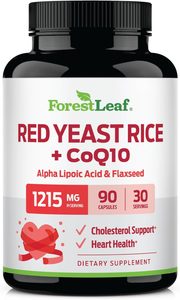
Price: $21.95 (as of Sep 29, 2026)
ForestLeaf is the only formula here that adds alpha lipoic acid and organic flaxseed to red yeast rice and CoQ10, and it carries a citrinin-free claim on the label.
Key Specs
- Active ingredient + form: Red yeast rice (Monascus purpureus) + CoQ10 (ubiquinone) + alpha lipoic acid + organic flaxseed
- Dose per serving: 1,215 mg red yeast rice, 60 mg CoQ10, 225 mg alpha lipoic acid, 300 mg organic flaxseed (3 capsules)
- Certifications: Citrinin free, non-GMO, made in the USA
- Third-party tested: Yes (potency and absorption, per brand)
- Citrinin-free claim: Yes
- Servings per container: 30
- Price per serving: $0.73 (calculated manually, price as of Sep 29, 2026)
Key Benefits
The 1,215 mg red yeast rice dose matches the lower end of clinical trial ranges, while the citrinin-free label addresses the main contamination concern with this ingredient.
Alpha lipoic acid adds antioxidant support. The flaxseed amount is small, so it works more as a complement than a meaningful source of fiber or omega-3s.
Key Ingredients
- Red Yeast Rice (Monascus purpureus, 1,215 mg): Supplies monacolins that slow the liver’s internal cholesterol production.
- Coenzyme Q10 (ubiquinone, 60 mg): Supports cellular energy production in heart and muscle tissue.
- Alpha Lipoic Acid (225 mg): An antioxidant that helps neutralize free radicals and recycle other antioxidants like vitamins C and E.
- Organic Flaxseed (300 mg): Provides small amounts of fiber, lignans, and plant-based omega-3 ALA.
Pros
- Citrinin-free claim printed directly on the label
- Four heart-focused ingredients in one routine
- Free of gluten, dairy, soy, nuts, eggs, and added sugar
Cons
- Highest price per serving in this guide at $0.73, because each bottle lasts only 30 days
- Requires 3 capsules daily
- 300 mg of flaxseed is far below the gram-level amounts used in cholesterol studies
Best Suited For
Adults who prefer one comprehensive heart-support routine and don’t mind paying more per day for the extra ingredients.
Usage Recommendations
Take 3 capsules daily with food, either together or split across meals. Some users open the capsules and mix the powder into yogurt or applesauce if swallowing is difficult.
Customer Feedback
Reviewers rate the overall quality highly, and many say their cholesterol readings improved over several months, often alongside diet changes. Several mention that their doctor suggested it. The capsules are frequently described as tasteless, odorless, and easy to swallow, and buyers appreciate having CoQ10 already included instead of buying it separately. Most say they plan to reorder.
A small group reported muscle aches and joint pain after a few weeks, and at least one needed medical care, a reminder that red yeast rice can cause statin-like reactions. People with a strong aversion to capsules found them too large, and the three-capsule dose feels like a lot for some.
Summary: ForestLeaf earns Best Multi-Ingredient Formula for pairing citrinin-free red yeast rice with CoQ10, alpha lipoic acid, and flaxseed in one routine.
3. Designs for Health Red Yeast Rice — Best Practitioner-Grade
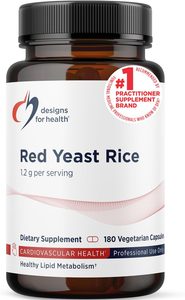
Price: $55.49 (as of Sep 29, 2026)
Designs for Health is one of the few brands that says it assays its red yeast rice for both citrinin and naturally occurring monacolin K, and the rice itself is USDA organic and grown in the U.S.
Key Specs
- Active ingredient + form: Organic red yeast rice (Monascus purpureus) powder
- Dose per serving: 1,200 mg (2 capsules)
- Certifications: USDA Organic, non-GMO, vegetarian, gluten free
- Third-party tested: Brand assays for citrinin and monacolins; independent certification not listed
- Citrinin-free claim: Tested to undetectable levels (per brand)
- Servings per container: 90
- Price per serving: $0.62 (calculated manually, price as of Sep 29, 2026)
Key Benefits
Testing for monacolin content addresses the biggest weakness in this category, since independent analyses have found large potency differences between red yeast rice brands.
U.S.-grown organic sourcing also adds traceability that most imported red yeast rice lacks.
Key Ingredients
- Organic Red Yeast Rice (Monascus purpureus, 1,200 mg): Provides monacolins that inhibit HMG-CoA reductase, with the brand assaying for appropriate monacolin K levels.
- L-Leucine (other ingredient): Used as a natural flow agent in place of magnesium stearate, not in a nutritionally meaningful amount.
Pros
- Assayed for both citrinin and monacolin content
- Organic, U.S.-grown red yeast rice
- 90-serving bottle lasts about three months
Cons
- Highest single-bottle cost in this guide at $55.49
- No CoQ10 included
- Some users report heartburn and headaches
Best Suited For
Adults who value ingredient sourcing and testing transparency and are willing to pay more for it, especially those working with a functional medicine practitioner.
Usage Recommendations
Take 2 capsules daily with an evening meal, or as directed by your practitioner. Add a separate CoQ10 supplement if your doctor recommends it.
Customer Feedback
Buyers generally describe it as a high-quality product with a clean ingredient list, and many say their doctor or practitioner is pleased with their follow-up lab results. Several report noticeable LDL improvements after consistent use, and some long-term users have stayed with it for years. The absence of preservatives and fillers is a recurring reason people choose it.
Tolerance feedback is mixed, with some users reporting heartburn, headaches, or stomach upset, including one long-term user who eventually stopped. Opinions on value are also divided: some feel the quality justifies the cost, while others see it as overpriced next to budget brands offering the same dose.
Summary: Designs for Health earns Best Practitioner-Grade for combining organic, U.S.-grown red yeast rice with testing for citrinin and monacolin content.
4. Nutricost Red Yeast Rice 1200 mg — Best Budget
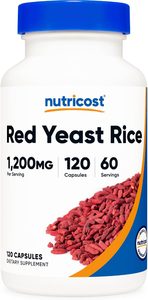
Price: $11.95 (as of Sep 29, 2026)
Nutricost delivers the standard 1,200 mg daily dose of red yeast rice for about $0.20 per serving, the lowest cost among full-dose products in this guide.
Key Specs
- Active ingredient + form: Red yeast rice (Monascus purpureus) powder
- Dose per serving: 1,200 mg (2 capsules)
- Certifications: GMO-free, gluten free, vegetarian; made in an NSF-certified, GMP-compliant, FDA-registered facility
- Third-party tested: Not stated for this product
- Citrinin-free claim: Not stated on label
- Servings per container: 60
- Price per serving: $0.20 (calculated manually, price as of Sep 29, 2026)
Key Benefits
It provides a single-ingredient, 1,200 mg dose with only a capsule and one flow agent, which makes it easy to pair with a CoQ10 product of your choice.
The low price suits long-term use, which matters because clinical trials typically measure results after 8–12 weeks of consistent use.
Key Ingredients
- Red Yeast Rice (Monascus purpureus powder, 1,200 mg): Supplies naturally occurring monacolins that reduce the liver’s cholesterol output.
- Magnesium Stearate (vegetable source): A standard flow agent used in small amounts during capsule manufacturing.
Pros
- Lowest cost per serving for a full 1,200 mg dose
- Simple two-capsule serving with a minimal ingredient list
- Manufactured in an NSF-certified facility
Cons
- No citrinin or monacolin information on the label
- No CoQ10, so a separate product is needed if your doctor recommends it
- Product-level third-party testing is not stated
Best Suited For
Budget-conscious adults who want plain red yeast rice and prefer to choose their own CoQ10 separately.
Usage Recommendations
Take 2 capsules once daily with a meal. Several users note it can upset the stomach when taken without food.
Customer Feedback
Users frequently say it does what they expected, with several reporting LDL readings back in the normal range at follow-up tests. Some mention starting it with their doctor’s approval before considering other options. Reviewers like that the capsules are flavorless and much easier to swallow than larger warehouse-club versions, and value for money is a common theme.
Negative reviews center on tolerance. A handful of users report muscle aches, body aches, or dizziness that resolved after stopping, and a few describe allergic-type reactions. Taking it on an empty stomach appears to cause discomfort for some, so pairing it with a meal is recommended.
Summary: Nutricost earns Best Budget by delivering a clinically common 1,200 mg dose in a simple, easy-to-swallow capsule at the lowest full-dose cost here.
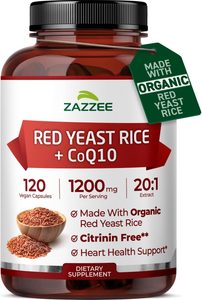
5. Zazzee Organic Red Yeast Rice + CoQ10 — Best Citrinin-Free Extract
Price: $19.97 (as of Sep 29, 2026)
Zazzee uses an organic 20:1 red yeast rice extract and states that each batch is screened by an ISO 17025-accredited lab to below 1 ppm citrinin.
Key Specs
- Active ingredient + form: Organic red yeast rice (Monascus purpureus) 20:1 extract + CoQ10 (ubiquinone)
- Dose per serving: 1,200 mg extract (stated as equivalent to 24,000 mg powder), 80 mg CoQ10 (2 capsules)
- Certifications: Organic red yeast rice, vegan, non-GMO, GMP, made in the USA, non-irradiated
- Third-party tested: Yes (citrinin screening by ISO 17025 lab)
- Citrinin-free claim: Yes, below 1 ppm
- Servings per container: 60
- Price per serving: $0.33 (calculated manually, price as of Sep 29, 2026)
Key Benefits
A specific citrinin threshold and a named lab accreditation give more verifiable safety information than a general “citrinin-free” label.
The added 80 mg of CoQ10 makes it a complete two-ingredient formula at a mid-range price.
Key Ingredients
- Organic Red Yeast Rice Extract (20:1, 1,200 mg): A concentrated extract of fermented rice that supplies monacolins, though the label does not state monacolin K content.
- Coenzyme Q10 (ubiquinone, 80 mg): Supports cellular energy production and helps offset CoQ10 depletion.
Pros
- Stated citrinin limit below 1 ppm, verified by an accredited lab
- Organic red yeast rice in a fully vegan capsule
- Includes 80 mg CoQ10 at $0.33 per serving
Cons
- Capsules are noticeably large
- A 20:1 ratio does not reveal actual monacolin content, so potency is hard to compare
- Reviewers say opened bottles cannot be returned on Amazon
Best Suited For
Adults whose top concern is citrinin contamination and who want organic, vegan red yeast rice with CoQ10 included.
Usage Recommendations
Take 2 capsules daily with a meal and do not exceed the labeled dose. Ask your doctor to check your cholesterol and liver enzymes after 8–12 weeks.
Customer Feedback
Most reviewers are happy with the quality for the price, and several say it helped them reach the daily amount their doctor recommended. Users who track their lipid panels generally report improvement, though some note they were also changing their diet and exercise habits at the same time. Repeat buyers appreciate having it available through Subscribe & Save.
Capsule size is the most common complaint, with many describing the pills as larger than expected. A few users developed body aches, hives, or stomach upset, and some were frustrated that the product could not be returned. Anyone who struggles with swallowing may prefer a smaller capsule.
Summary: Zazzee earns Best Citrinin-Free Extract thanks to its organic source, a stated sub-1 ppm citrinin limit, and CoQ10 at a mid-range price.
6. aSquared Nutrition Red Yeast Rice 1800 mg — Best High-Dose
Price: $29.99 (as of Sep 29, 2026)
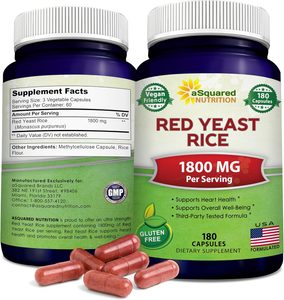
aSquared provides 1,800 mg of red yeast rice powder per serving, the highest labeled powder dose in this guide, in a simple vegan capsule.
Key Specs
- Active ingredient + form: Red yeast rice (Monascus purpureus) powder
- Dose per serving: 1,800 mg (3 capsules, 600 mg each)
- Certifications: Vegan, gluten free, GMP
- Third-party tested: Yes (per label)
- Citrinin-free claim: Not stated on label
- Servings per container: 60
- Price per serving: $0.50 (calculated manually, price as of Sep 29, 2026)
Key Benefits
The 1,800 mg daily dose falls in the middle of the 1,200–2,400 mg range used in clinical research, and 600 mg capsules make it easy to split the dose across meals.
The formula contains only red yeast rice, a methylcellulose capsule, and rice flour.
Key Ingredients
- Red Yeast Rice (Monascus purpureus powder, 1,800 mg): Provides monacolins along with naturally occurring sterols and unsaturated fatty acids from the fermentation process.
- Rice Flour (other ingredient): A simple filler used to standardize capsule fill.
Pros
- Higher labeled dose than most competitors
- 600 mg capsules can be spread across three meals
- 60-day supply in a vegan, gluten-free formula
Cons
- No citrinin or monacolin information on the label
- Three capsules per serving
- Lowest average rating in this guide at 4.4/5
Best Suited For
Adults whose healthcare provider recommends more than 1,200 mg daily and who prefer a single-ingredient product.
Usage Recommendations
Take 3 capsules daily, ideally 1 capsule with each meal. Starting with 1–2 capsules and building up gradually may reduce stomach discomfort.
Customer Feedback
Most reviewers give it strong marks for effectiveness, with many saying it helps keep their cholesterol numbers in check over time. Several consider it a reasonably priced way to get a higher dose, and repeat buyers mention consistent results from bottle to bottle. Fast shipping and the straightforward, single-ingredient formula also come up often in positive feedback.
The main drawback is the pill count. Some users felt nauseated taking three capsules at once, and a few reported bloating and fatigue. Because it has fewer reviews than most products here, long-term tolerance feedback from buyers is more limited.
Summary: aSquared earns Best High-Dose for offering 1,800 mg of red yeast rice per serving in a simple vegan formula at a moderate price.
7. NaturesPlus Herbal Actives Red Yeast Rice — Best for Flexible Dosing
Price: $95.12 (as of Sep 29, 2026)
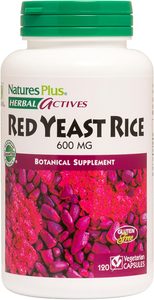
NaturesPlus Herbal Actives provides a standardized 600 mg red yeast rice extract in a single capsule, making it easy to adjust your daily intake in small steps.
Dose note: One capsule provides 600 mg, half the 1,200 mg starting dose used by most products here and in many clinical studies. Reaching 1,200 mg requires 2 capsules, which raises the effective cost to about $0.79 per day.
Key Specs
- Active ingredient + form: Red yeast rice (Monascus purpureus) standardized extract
- Dose per serving: 600 mg (1 capsule)
- Certifications: Vegan, gluten free; cGMP, made in an FDA- and NSF-registered facility
- Third-party tested: Not stated
- Citrinin-free claim: Not stated on label
- Servings per container: 240 (2 bottles × 120 capsules; a single 120-count bottle is also sold)
- Price per serving: $0.40 (calculated manually, price as of Sep 29, 2026)
Key Benefits
The brand describes its extract as uniformly standardized, which aims for more consistent batches than unstandardized powders.
The one-capsule serving lets users start low and build up to their provider’s recommended dose, and many reviewers are long-term users.
Key Ingredients
- Red Yeast Rice Extract (Monascus purpureus, 600 mg): A standardized extract supplying the naturally occurring monacolins found in fermented red yeast rice.
- Vegetable Cellulose, Microcrystalline Cellulose, Silica (other ingredients): Standard capsule and flow ingredients.
Pros
- Highest average rating in this guide at 4.7/5
- 600 mg capsules allow gradual, flexible dosing
- Long-established brand with a vegan, gluten-free formula
Cons
- Lower dose per serving than most competitors
- Highest cost per 1,200 mg in this guide (about $0.79)
- Smallest review base on this list
Best Suited For
Adults who want to start with a lower dose and increase gradually under medical supervision, or who prefer a long-established brand.
Usage Recommendations
Start with 1 capsule daily with an evening meal. Increase to 2 capsules only if your healthcare provider recommends it after reviewing your lab results.
Customer Feedback
Satisfied buyers are often long-term users, with some saying they have taken it daily for many years. Several report that it helps keep their LDL near their target, and most say they have not noticed side effects or stomach issues. Reviewers who compared prices generally feel the Amazon listing offers good value for a trusted brand.
A few users experienced problems, including pain in the back and shoulders that eased after stopping, and one described feeling slightly off for a couple of hours after each dose. With fewer than 400 ratings, it also has the smallest pool of buyer feedback here.
Summary: NaturesPlus earns Best for Flexible Dosing with a standardized 600 mg single-capsule serving that lets users fine-tune intake with their doctor.
8. NatureBell Red Yeast Rice with CoQ10 — Best Small Capsule
Price: $24.99 (as of Sep 29, 2026)
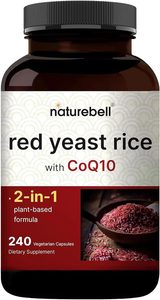
NatureBell combines a 4:1 red yeast rice extract with 100 mg of CoQ10 in small vegetarian capsules, with 120 servings in each bottle.
Dose note: Each serving provides 600 mg of 4:1 extract, and the brand does not state monacolin content. Some reviewers felt it was milder than they expected, so it may not match the strength of 1,200 mg formulas.
Key Specs
- Active ingredient + form: Red yeast rice (Monascus purpureus) 4:1 extract + CoQ10 (ubiquinone)
- Dose per serving: 600 mg extract, 100 mg CoQ10 (2 capsules)
- Certifications: Non-GMO; free of gluten, soy, dairy, tree nuts, and preservatives
- Third-party tested: Yes (quality and potency, per brand)
- Citrinin-free claim: Not stated on label
- Servings per container: 120
- Price per serving: $0.21 (calculated manually, price as of Sep 29, 2026)
Key Benefits
It provides 100 mg of CoQ10, tying for the highest amount in this guide, at about $0.21 per serving.
The four-month supply and small capsule size make daily use easier for people who struggle with larger pills.
Key Ingredients
- Red Yeast Rice Extract (4:1, 600 mg): A concentrated extract supplying monacolins, though actual monacolin content is not disclosed.
- Coenzyme Q10 (ubiquinone, 100 mg): Supports mitochondrial energy production in heart and muscle cells.
Pros
- Smaller capsules than most red yeast rice products
- Lowest cost per serving among red yeast rice and CoQ10 combinations
- 120 servings per bottle with third-party testing
Cons
- Lower red yeast rice dose than most products here
- Monacolin and citrinin information not disclosed
- Reviewers say the product is not returnable once opened
Best Suited For
Adults who have difficulty swallowing large capsules and want an affordable red yeast rice and CoQ10 combination.
Usage Recommendations
Take 2 capsules daily with food. Check your lipid panel after 8–12 weeks to see whether this milder dose meets your needs.
Customer Feedback
The most praised feature is capsule size, with many users saying these are smaller and easier to swallow than other red yeast rice products they have tried. Reviewers also describe them as tasteless and good value, and several long-term users say it helps keep their cholesterol in a healthy range. Some chose it because they could not tolerate prescription options.
Some buyers expected a stronger product and felt the dose was weaker than advertised. Side effect reports include muscle cramps, dizziness, fatigue, and digestive discomfort after a couple of weeks, and a few were unhappy that opened bottles cannot be returned.
Summary: NatureBell earns Best Small Capsule for pairing red yeast rice with 100 mg CoQ10 in easy-to-swallow capsules at a low daily cost.
Evidence-Based Ingredients
Red Yeast Rice (Monacolin K)
Red yeast rice has been used in Chinese cooking and traditional medicine for centuries, but its modern use rests on clinical trials rather than tradition. Randomized controlled trials, including a 1999 UCLA study using 2.4 g daily and a 2009 trial in statin-intolerant adults published in Annals of Internal Medicine, found meaningful LDL reductions compared with placebo.
The key limitation is that trials used carefully standardized products, while retail supplements vary widely in monacolin content.
Coenzyme Q10
The reason for pairing CoQ10 with red yeast rice is mechanistic: blocking HMG-CoA reductase also reduces the body’s own CoQ10 production. Randomized trials testing whether CoQ10 prevents statin-related muscle symptoms have produced mixed results, with some meta-analyses showing benefit and others showing none.
Alpha Lipoic Acid
Alpha lipoic acid is a well-studied antioxidant, but most of its human trial evidence relates to blood sugar and nerve health rather than cholesterol. Its role in red yeast rice formulas is supported mainly by mechanistic and antioxidant research.
Flaxseed
Meta-analyses suggest whole ground flaxseed can modestly lower LDL, but those studies used several grams or more per day. The 300 mg found in capsule formulas is far below studied amounts and should be viewed as a minor addition.
The ingredients in our top picks range from strong clinical backing (red yeast rice) to mixed or emerging evidence (CoQ10, alpha lipoic acid, and low-dose flaxseed). They are not treatments for high cholesterol or heart disease and should not replace medical care.
What Are Red Yeast Rice Supplements?
Red yeast rice is made by fermenting white rice with the mold Monascus purpureus, which turns the grain deep red. The fermentation produces a group of compounds called monacolins, the most important being monacolin K.
Monacolin K is chemically identical to lovastatin, a prescription cholesterol medication. This is why red yeast rice can influence cholesterol levels, and also why it can cause similar side effects.
In the U.S., the FDA has taken the position that red yeast rice products containing more than trace amounts of lovastatin may be considered unapproved drugs. As a result, most U.S. brands do not list monacolin K content on their labels, which makes it hard for shoppers to compare potency.
Common Signs You May Need Red Yeast Rice Support
High cholesterol rarely causes symptoms, so a blood test is the only reliable way to know where you stand. People commonly consider red yeast rice in situations like these:
- A routine lipid panel shows LDL cholesterol slightly above your target range
- Your doctor has recommended trying lifestyle changes before other options
- You have a family history of high cholesterol and want to be proactive with your provider
- You have been advised to monitor lipid levels more closely because of age or other risk factors
Key Ingredients to Look For
Red yeast rice at 1,200–2,400 mg daily. This is the range used in most clinical trials. Lower doses may be milder, and extracts should ideally disclose what their concentration ratio means in practice.
Citrinin testing. Citrinin is a toxin that can form during fermentation and may harm the kidneys. Look for a clear citrinin-free claim, ideally with a stated limit or testing lab.
CoQ10 at 60–100 mg. Because monacolin K can reduce the body’s CoQ10 production, many formulas add it. The evidence for muscle-symptom prevention is mixed, but it is a reasonable addition for many users.
Monacolin transparency. Brands that say they assay for monacolin K content offer more consistency, even if they cannot print exact amounts on U.S. labels.
How to Choose
- Contamination testing: Prioritize products that state citrinin testing, preferably with a specific threshold or accredited lab.
- Dose: Compare the red yeast rice amount per serving and how many capsules it takes to reach it.
- Third-party testing: Independent verification of purity and potency matters more in this category than most, because potency varies so widely.
- Formula: Decide whether you want red yeast rice alone or combined with CoQ10 and other ingredients.
- Price per serving: Calculate cost per daily dose, not per bottle, since serving sizes range from 1 to 3 capsules.
Who May Benefit
- Adults with mildly elevated LDL whose doctor agrees to a trial of lifestyle changes plus a supplement
- People who want to support healthy cholesterol levels alongside diet and exercise, with regular lab monitoring
- Adults who prefer a food-derived option and are willing to follow up with blood work to track results
- Those looking for a combination product that pairs red yeast rice with CoQ10 in one routine
Safety and Side Effects
Because monacolin K is identical to lovastatin, red yeast rice can cause the same side effects as the medication. The most commonly reported are muscle aches, stomach upset, heartburn, and headaches. Rarely, it can cause liver problems or serious muscle damage.
Do not combine red yeast rice with:
- Statins or other cholesterol medications, including fibrates like gemfibrozil
- Medications that block the CYP3A4 enzyme, such as certain antibiotics (clarithromycin, erythromycin), azole antifungals, HIV protease inhibitors, and cyclosporine
- Large amounts of grapefruit juice, which can raise lovastatin levels in the blood
- Heavy alcohol use
Who should avoid it: People who are pregnant or breastfeeding, anyone under 18, and people with liver disease or kidney disease should not take red yeast rice.
Contamination matters. In 2024, Japan’s Kobayashi Pharmaceutical recalled red yeast rice (beni-koji) supplements after reports of kidney damage and deaths. Investigators later linked the problem to puberulic acid, a contaminant from a different mold, which highlights why manufacturing controls and testing are important.
Regulation also varies by country. The European Union, for example, limits monacolins from red yeast rice to less than 3 mg per daily portion.
What Results Can You Expect?
Clinical trials have generally measured LDL changes after about 8–12 weeks of consistent daily use. Results vary widely between people and between products, largely because monacolin content differs so much from brand to brand.
The only way to know whether a supplement is working for you is a follow-up lipid panel. Many doctors also check liver enzymes at the same time. If your numbers do not change after about three months, talk with your provider about other options rather than increasing the dose on your own.
Lifestyle Tips
- Eat more soluble fiber. Oats, beans, lentils, and barley help bind cholesterol in the digestive tract.
- Limit saturated and trans fats. Swap butter and fatty cuts of meat for olive oil, nuts, and fish.
- Stay active. Regular aerobic exercise can help raise HDL and support healthy LDL levels.
- Consider omega-3s. Fatty fish or a quality supplement may support healthy triglyceride levels. See our guide to the [best omega-3 supplements](INTERNAL LINK).
- Retest regularly. Schedule lipid panels as your doctor recommends so you can track whether your routine is working.
FAQ
Not exactly, but the main active compound is. Monacolin K in red yeast rice is chemically identical to lovastatin. The difference is that supplements are not standardized like medication, so the amount of monacolin K can vary widely between products and even between batches. Red yeast rice should not be used as a substitute for prescribed medication without your doctor’s guidance.
In the U.S., the FDA considers red yeast rice products containing more than trace amounts of lovastatin to be potential unapproved drugs. As a result, most brands avoid stating monacolin K amounts on their labels. Some manufacturers, such as Designs for Health, say they assay their products for monacolin content even though exact amounts are not printed.
Citrinin is a toxin that can form when Monascus purpureus ferments rice, and it may damage the kidneys. A citrinin-free claim means the manufacturer tested the product and found citrinin below a detectable or specified limit. The most useful claims name a threshold, such as below 1 ppm, or identify the testing lab.
Most clinical trials used 1,200 to 2,400 mg of red yeast rice daily, often split into two doses taken with meals. Start with the dose on the product label and only increase under medical supervision. Because potency varies between brands, the same milligram amount from two products may not have the same effect.
Most studies measured results after 8 to 12 weeks of consistent use. A follow-up lipid panel around that point is the best way to see whether the supplement is working for you. If you notice muscle pain, dark urine, or unusual fatigue before then, stop taking it and contact your doctor.
Many people do, because monacolin K can reduce the body’s own CoQ10 production. Research on whether CoQ10 prevents muscle aches is mixed, but it is generally well tolerated. Several products in this guide already include 60 to 100 mg of CoQ10, which can save you from buying it separately.
No, not without medical guidance. Combining red yeast rice with statins, fibrates, or drugs that block the CYP3A4 enzyme (including certain antibiotics, antifungals, and HIV medications) raises the risk of muscle and liver damage. Large amounts of grapefruit juice can have a similar effect. Always review your full medication list with your doctor or pharmacist first.
Final Thoughts
Our top pick is Nature’s Craft Red Yeast Rice + CoQ10, which combines a 1,200 mg dose with 100 mg of CoQ10 at a fair price and has the largest review base in this guide.
If contamination testing is your top priority, Zazzee Organic Red Yeast Rice + CoQ10 states a sub-1 ppm citrinin limit, while Designs for Health Red Yeast Rice tests for both citrinin and monacolin content. On a tight budget, Nutricost Red Yeast Rice 1200 mg delivers the standard dose for about $0.20 per serving.
If your LDL is significantly elevated, you already take cholesterol medication, or you have liver or kidney concerns, see your doctor before trying red yeast rice rather than relying on a supplement alone.