
- Our Top Picks for Eyesight Improvement Supplements
- Comparison Table
- 1. Best Overall: NATURELO Eye Vitamins, AREDS 2 Formula (60 Vegan Capsules)
- 2. Best for Dry Eyes & Screen Strain: Physician’s Choice AREDS 2 Eye Vitamins (60 Capsules)
- 3. Best for Optic Nerve & Eye Comfort: Neuroptene Bilberry Supplement (60 Capsules)
- 4. Best Astaxanthin for Digital Eye Fatigue: Double Wood Astaxanthin 12mg (60 Softgels)
- 5. Best Single-Ingredient Saffron: Luma Nutrition Saffron Supplement (60 Capsules)
- 6. Best Comprehensive Antioxidant Formula: DR Vitamin Solutions Ultra Eye + Vision Support (60 Capsules)
- Evidence-Based Ingredients
- What Are Eyesight Improvement Supplements?
- Common Signs You May Need Eye Support
- Key Ingredients to Look For
- How to Choose
- Who May Benefit
- Safety and Side Effects
- What Results Can You Expect?
- Lifestyle Tips
- Frequently Asked Questions (FAQ)
Screens, sun exposure, and simple aging all take a toll on your eyes — and for a lot of people, that shows up as blurry vision, dryness, or that gritty, tired feeling by the end of the day.
Nutrition plays a real role here. Carotenoids like lutein and zeaxanthin concentrate directly in the macula, the part of the retina responsible for your sharpest vision, while antioxidants help offset the oxidative stress your eyes are constantly exposed to.
This guide compares six of the best-reviewed eye supplements on the market — from full AREDS2 formulas to targeted single-ingredient options — so you can match the right one to what your eyes actually need.
Our Top Picks for Eyesight Improvement Supplements
Best Overall: NATURELO Eye Vitamins, AREDS 2 Formula — Full-strength AREDS2 formula with algae-based DHA, ideal for vegans wanting complete macular support.
Best for Dry Eyes & Screen Strain: Physician’s Choice AREDS 2 Eye Vitamins — Clinically-tested Lutemax 2020 carotenoids plus bilberry ease digital eye fatigue and dryness.
Best for Optic Nerve & Eye Comfort: Neuroptene Bilberry Supplement — Bilberry, saffron, and CoQ10 blend supports circulation and antioxidant defense for the optic nerve.
Best Astaxanthin for Digital Eye Fatigue: Double Wood Astaxanthin 12mg — High-potency 12mg AstaReal astaxanthin, a well-studied antioxidant for screen-related eye tiredness.
Best Single-Ingredient Saffron: Luma Nutrition Saffron Supplement — Concentrated saffron extract traditionally used to support retinal function and visual comfort.
Best Comprehensive Antioxidant Formula: DR Vitamin Solutions Ultra Eye + Vision Support — Broad blend of lutein, bilberry, and glutathione for wide-ranging antioxidant eye support.
Comparison Table
| Rank | Product | Form | Price/Serving | Best For |
|---|---|---|---|---|
| 1 | NATURELO Eye Vitamins, AREDS 2 Formula | Capsule | $0.79 | Vegans and vegetarians wanting a complete, plant-based AREDS2 formula |
| 2 | Physician’s Choice AREDS 2 Eye Vitamins | Capsule | $0.80 | Anyone doing heavy daily screen time who wants clinically studied carotenoids |
| 3 | Neuroptene Bilberry Supplement | Capsule | $1.17 | Those wanting circulation and antioxidant support for the optic nerve, not a core AREDS2 replacement |
| 4 | Double Wood Astaxanthin 12mg | Softgel | $0.43 | People wanting a targeted, single-ingredient antioxidant for eye fatigue |
| 5 | Luma Nutrition Saffron Supplement | Capsule | $0.37 | Those wanting to add saffron specifically, alongside a core AREDS2 formula |
| 6 | DR Vitamin Solutions Ultra Eye + Vision Support | Capsule | $1.10 | Users wanting the broadest antioxidant blend beyond standard AREDS2 nutrients |
1. Best Overall: NATURELO Eye Vitamins, AREDS 2 Formula (60 Vegan Capsules)
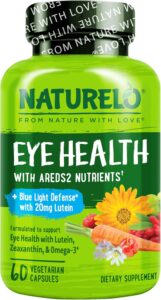
NATURELO’s AREDS2 formula is the most complete match to the original AREDS2 clinical trial nutrients of any product in this guide, and it’s one of the only vegan options — using algae-derived DHA instead of fish oil. It rounds out the core nutrients with carrot powder, eyebright, goji berry, and grape seed extract.
Key Benefits
NATURELO delivers the full 500mg vitamin C dose used in the original AREDS2 research, along with lutein and zeaxanthin in a well-studied ratio — making it one of the more clinically aligned formulas available.
The added algae-based DHA and plant carotenoids give it broader coverage than a bare-bones AREDS2 formula, without relying on fish oil.
Key Specs
- Active ingredient + form: Lutein and Zeaxanthin (from marigold flower extract), plus AREDS2 core nutrients
- Dose per serving: Lutein 20mg, Zeaxanthin 4mg, Vitamin C 500mg, Vitamin E 160mg, Zinc 30mg, Copper 2mg, Selenium 55mcg (2 capsules)
- Certifications: Vegan, Non-GMO, Gluten-Free, Soy-Free, GMP Certified, Third-Party Tested
- Third-party tested: Yes
- Servings per container: 30
Key Ingredients
- Lutein & Zeaxanthin (20mg / 4mg, from marigold flower extract): Macular carotenoids that filter blue light and concentrate directly in retinal tissue.
- Vitamin C (500mg) & Vitamin E (160mg): Antioxidants matching the AREDS2 trial’s core dosing more closely than most competing formulas.
- Omega-3 DHA (25mg, from algae oil): A plant-based structural fat for the retina, avoiding fish-derived sourcing.
- Eyebright, Goji Berry, Grape Seed Extract: Traditional and antioxidant-supporting botanicals rounding out the formula.
Pros
- Closest match to full AREDS2 clinical dosing among all six products here
- Vegan-friendly with algae-based DHA instead of fish oil
- Broad ingredient list covering carotenoids, antioxidants, and traditional eye herbs
- Third-party tested, GMP-certified US manufacturing
Cons
- Vitamin E (160mg) is still below the 400 IU used in the original AREDS2 trial, though higher than most competitors in this guide
- A minority of reviewers report a mild fishy or algae aftertaste despite the plant-based DHA source
- Two capsules per serving is less convenient than single-capsule options
Best Suited For
Vegans, vegetarians, or anyone wanting an eye supplement that tracks closely with the original AREDS2 research while avoiding fish oil and animal-derived ingredients.
Usage Recommendations
Take 2 capsules daily, ideally with a meal to support absorption of the fat-soluble vitamins and carotenoids.
Customer Feedback
Reviewers frequently report improved close-range and night vision along with reduced dryness, and several specifically praise the natural, plant-based ingredient list compared to standard multivitamin-style AREDS2 formulas. Digestive tolerance is generally good, with many noting no stomach upset.
A smaller group found the effect too subtle to notice, and a few mentioned a mild fishy aftertaste from the algae-based DHA. Opinions on value are mixed, with some calling it worth the price and others considering it pricier than simpler formulas.
Summary: NATURELO’s AREDS2 Formula earns the top spot for combining accurate clinical-trial dosing with a fully vegan, plant-based ingredient list — a rare combination that makes it the most complete option in this guide.
2. Best for Dry Eyes & Screen Strain: Physician’s Choice AREDS 2 Eye Vitamins (60 Capsules)
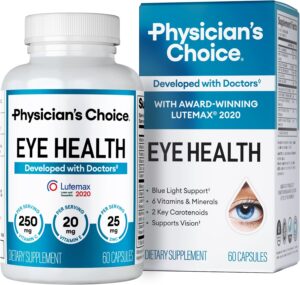
Physician’s Choice built this formula around Lutemax 2020, a clinically studied carotenoid complex delivering lutein and zeaxanthin in the well-researched 5:1 ratio. It’s the most-reviewed product in this guide, backed by 9,000+ ratings, and adds bilberry and grape seed extract for extra antioxidant coverage.
Key Benefits
Lutemax 2020 has been studied specifically for reducing occasional eye strain and supporting visual comfort during extended screen exposure, which is reflected heavily in this product’s reviewer feedback around dryness and digital fatigue.
The added BioPerine black pepper extract is included to support absorption of the carotenoid blend.
Key Specs
- Active ingredient + form: Lutein and Zeaxanthin (from Lutemax 2020 marigold flower extract, 5:1 ratio)
- Dose per serving: Lutein 20mg, Zeaxanthin 4mg, Vitamin C 250mg, Vitamin E 20mg, Zinc 25mg, Copper 2mg (2 capsules)
- Certifications: Gluten-Free, Third-Party Tested, Formulated Without Major Allergens
- Third-party tested: Yes
- Servings per container: 30
Key Ingredients
- Lutemax 2020 Lutein & Zeaxanthin (20mg / 4mg): A clinically studied 5:1 carotenoid ratio linked in research to reduced eye strain from blue light exposure.
- Bilberry Fruit Extract (50mg) & Grape Seed Extract (25mg): Anthocyanin-rich botanicals supporting microcirculation and antioxidant defense.
- BioPerine Black Pepper Extract (5mg): Included to enhance absorption of the carotenoid blend.
Pros
- Uses the clinically studied Lutemax 2020 carotenoid complex
- Formulated without dairy, soy, gluten, wheat, or common allergens
- Large, well-established review base with consistent positive feedback on dryness and strain
Cons
- Dose disclaimer: at 250mg vitamin C and 20mg vitamin E, this formula runs notably lower than NATURELO’s on both nutrients, which are two of the six core AREDS2 ingredients
- A meaningful share of reviewers report nausea or headaches, especially when taken without food
Best Suited For
Adults spending long hours on screens who want a clinically studied carotenoid complex specifically aimed at digital eye strain and dryness.
Usage Recommendations
Take 2 veggie capsules daily, preferably with food to reduce the chance of stomach upset.
Customer Feedback
Many reviewers report noticeably less eye strain, dryness, and fatigue after several weeks of consistent use, with several specifically mentioning improved comfort during long periods of screen or reading time. Sharper night vision and reduced tearing are also common themes.
A recurring complaint is nausea or headaches within an hour of taking it, which a portion of reviewers attribute to taking it on an empty stomach. Opinions on value are mixed, with some reviewers unaware the vitamin C and E doses run lower than other AREDS2 formulas until reading the label closely.
Summary: Physician’s Choice AREDS 2 stands out for its clinically studied Lutemax 2020 carotenoid complex and strong track record with dry eyes and screen fatigue, though its lower vitamin C and E doses are worth factoring in against fuller AREDS2 formulas.
3. Best for Optic Nerve & Eye Comfort: Neuroptene Bilberry Supplement (60 Capsules)
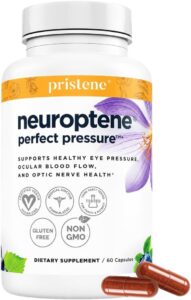
Neuroptene takes a different approach than the AREDS2-style formulas above, combining bilberry, saffron, grape seed extract, CoQ10, and high-dose niacinamide. It’s positioned around general circulation and antioxidant support for the optic nerve rather than macular pigment density specifically.
Key Benefits
This formula leans on bilberry’s traditional use for night vision and capillary support, paired with CoQ10’s role in cellular energy production — a combination more commonly associated with general eye comfort and circulation than with macular carotenoid density.
It’s worth noting this is not an AREDS2-style formula: it contains no lutein, zeaxanthin, or zinc, so it works best as a complement to, not a replacement for, a core AREDS2 supplement.
Key Specs
- Active ingredient + form: Bilberry Fruit Powder, Saffron Bulb Extract, Grape Seed Extract, Coenzyme Q10
- Dose per serving: Bilberry 160mg, Grape Seed Extract 100mg (95mg proanthocyanidins), CoQ10 50mg, Saffron 30mg, Niacin 250mg NE (2 capsules)
- Certifications: Non-GMO, Certified Vegan, Gluten-Free, Third-Party Tested
- Third-party tested: Yes
- Servings per container: 30
Key Ingredients
- Bilberry Fruit Powder (160mg): Rich in anthocyanins traditionally used to support night vision and capillary circulation.
- Coenzyme Q10 (50mg): Supports cellular energy production; studied in a general antioxidant and circulatory context relevant to optic nerve tissue.
- Saffron Bulb Extract (30mg): Included for its traditional and emerging-evidence role in retinal comfort.
- Grape Seed Extract (100mg, 95% proanthocyanidins): A concentrated antioxidant supporting vascular health.
Cons note: This formula does not contain lutein, zeaxanthin, or zinc, so it’s not a substitute for a core AREDS2 supplement — it’s best used alongside one, not instead of it.
Pros
- Certified vegan with third-party lab testing
- Includes CoQ10 and saffron, ingredients rarely combined in standard eye formulas
- Strong reviewer feedback specifically around eye comfort and pressure-related discomfort
Cons
- No lutein, zeaxanthin, or zinc — not a core AREDS2 formula
- Highest price per serving among the AREDS2-adjacent products in this guide
- Contains a high dose of niacin (250mg NE), which can cause flushing in sensitive individuals
Best Suited For
Adults wanting additional circulation and antioxidant support for general eye comfort, used alongside — not instead of — a core AREDS2 supplement.
Usage Recommendations
Take 2 capsules daily, as directed on the label.
Customer Feedback
Reviewers frequently mention improved eye comfort and reduced strain, with several specifically noting they take it for general eye wellness support and appreciate the inclusion of saffron and CoQ10. Ease of swallowing and lack of aftertaste are also commonly praised.
A portion of reviewers felt the price was high relative to the noticeable benefit, and a few reported no significant difference after several weeks of use. Value-for-money feedback is more mixed here than for the AREDS2-style formulas in this guide.
Summary: Neuroptene offers a differentiated, circulation-focused approach to eye comfort with CoQ10 and saffron, but its lack of core AREDS2 nutrients means it’s best positioned as an add-on rather than a primary eye supplement.
4. Best Astaxanthin for Digital Eye Fatigue: Double Wood Astaxanthin 12mg (60 Softgels)
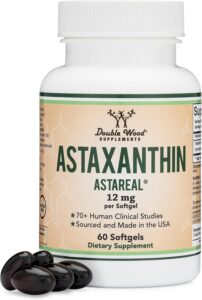
Double Wood’s Astaxanthin uses AstaReal, a patented, clinically studied strain grown in the USA. At 12mg per softgel, it sits at the top of the typical astaxanthin dosing range, and it’s the highest-rated product in this entire guide.
Key Benefits
Astaxanthin is one of the most-researched antioxidants for screen-related eye fatigue specifically, with studies on the AstaReal strain used here supporting its role in reducing visual tiredness during prolonged near-work.
Reviewers frequently combine it with a core AREDS2 formula rather than using it as a standalone eye supplement.
Key Specs
- Active ingredient + form: Astaxanthin (AstaReal, from Haematococcus pluvialis microalgae)
- Dose per serving: 12mg per softgel
- Certifications: GMP Certified Facility, Third-Party Tested, Made in the USA
- Third-party tested: Yes
- Servings per container: 60
Key Ingredients
- Astaxanthin (12mg, AstaReal strain from microalgae): A carotenoid antioxidant studied in over 70 human trials, with research specific to reducing eye fatigue and supporting blood flow to the retina.
Pros
- Uses the clinically studied AstaReal astaxanthin strain, backed by 70+ human trials
- 12mg dose sits at the higher, more clinically relevant end of the typical range
- Highest average rating of any product in this guide
- Simple, single-ingredient formula with no proprietary blends
Cons
- Single-ingredient formula — does not provide the lutein, zeaxanthin, or zinc found in AREDS2 products
- Not for use during pregnancy, nursing, or under 18 per the label
Best Suited For
Anyone wanting a targeted, well-studied antioxidant specifically for screen-related eye fatigue, layered on top of a core AREDS2 supplement rather than replacing one.
Usage Recommendations
Take 1 softgel daily, ideally with a meal for better absorption of this fat-soluble antioxidant.
Customer Feedback
Reviewers consistently report noticeable results within about a week, particularly for reduced eye tiredness, improved skin appearance, and general antioxidant support. Several specifically compare it favorably to pricier astaxanthin brands, citing similar effectiveness at a lower cost.
A smaller number of reviewers didn’t notice a clear difference, and one mentioned migraines after starting the supplement. Overall sentiment is strongly positive, with side effects reported far less frequently than benefits.
Summary: Double Wood Astaxanthin stands out for using a clinically validated strain at a meaningfully high dose, backed by the strongest review ratings in this guide — a solid, single-ingredient addition for anyone dealing with screen-related eye fatigue.
5. Best Single-Ingredient Saffron: Luma Nutrition Saffron Supplement (60 Capsules)
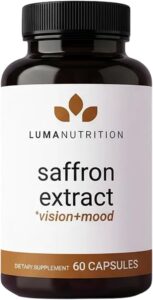
Luma Nutrition’s saffron capsules deliver a concentrated 88.5mg dose per serving, made in a GMP-certified US facility. Saffron has drawn growing research interest for retinal support, and this product’s reviews lean heavily toward mood and visual comfort improvements.
Key Benefits
Saffron extract has been studied in small clinical trials for supporting retinal sensitivity and visual comfort, and reviewers here frequently report subjective improvements in night vision clarity alongside mood benefits.
Because saffron research generally uses more modest doses, this product’s 88.5mg serving is on the higher end — worth being aware of if combining it with a multi-ingredient formula that also contains saffron, such as Neuroptene above.
Key Specs
- Active ingredient + form: Saffron Extract (Crocus sativus, flower)
- Dose per serving: 88.5mg per capsule
- Certifications: Made in the USA
- Third-party tested: Not specified on the label
- Servings per container: 60
Key Ingredients
- Saffron Extract (88.5mg, Crocus sativus flower): Contains crocin and safranal, compounds studied in small trials for retinal function and mood support.
Pros
- Simple, single-ingredient formula free of common allergens
- Made in a GMP-certified US facility
- Strong reviewer feedback on mood alongside eye comfort
Cons
- Dose disclaimer: at 88.5mg, this is a notably higher saffron dose than the amounts typically used in eye-health research (commonly in the 20–30mg range) — those combining it with other saffron-containing products should watch total daily intake
- Label doesn’t specify third-party testing, unlike most other products in this guide
- Effectiveness feedback is more mixed than for the AREDS2-style formulas above
Best Suited For
Adults specifically wanting to add saffron to their routine for visual comfort and mood support, on top of a core AREDS2 formula rather than as a standalone eye supplement.
Usage Recommendations
Take 1 capsule daily. Do not exceed the recommended dose, and consult a physician before use if pregnant, nursing, or managing an existing medical condition.
Customer Feedback
Reviewers frequently describe improved mood alongside noticeable eye comfort, with several specifically mentioning reduced night-time blurriness and calmer overall well-being. Many say the effect became noticeable after a few weeks of consistent use.
A meaningful portion of reviewers reported no noticeable difference after a month of use, and a smaller group experienced nausea, cramping, or bloating. Value-for-money feedback is split between strong advocates and reviewers who felt it didn’t justify the cost.
Summary: Luma Nutrition Saffron offers a concentrated, single-ingredient way to add saffron’s traditional and emerging retinal benefits to a supplement routine, though its higher-than-typical dose and mixed effectiveness reviews mean it works best as a targeted add-on rather than a primary eye supplement.
6. Best Comprehensive Antioxidant Formula: DR Vitamin Solutions Ultra Eye + Vision Support (60 Capsules)
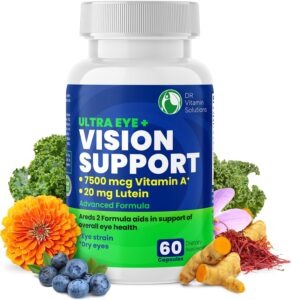
This formula casts the widest net of any product in this guide, combining lutein, zinc, and high-dose beta-carotene with bilberry, grape seed, quercetin, taurine, milk thistle, turmeric, and glutathione. It’s built for broad antioxidant coverage rather than tight AREDS2-trial dosing.
Key Benefits
The formula’s strength is breadth — combining macular carotenoids with a wide range of antioxidants (glutathione, quercetin, turmeric) that support the body’s overall oxidative-stress defenses, which several reviewers link to reduced eye strain and improved comfort.
Key Specs
- Active ingredient + form: Lutein (from marigold extract), Zinc, Vitamin A (as beta-carotene), plus a broad antioxidant blend
- Dose per serving: Vitamin A 7,500mcg (as beta-carotene), Zinc 25mg, Lutein 20mg, Bilberry 80mg, Grape Seed Extract 100mg, Quercetin 100mg, Taurine 400mg, Milk Thistle 160mg, Turmeric 20mg, L-Glutathione 20mg (2 capsules)
- Certifications: Gluten-Free, Non-GMO, Third-Party Tested
- Third-party tested: Yes
- Servings per container: 30
Key Ingredients
- Vitamin A as Beta-Carotene (7,500mcg): Supports night vision and corneal health; see the safety note below on beta-carotene and smoking.
- Bilberry (80mg) & Grape Seed Extract (100mg): Support microcirculation and antioxidant defense.
- Taurine (400mg) & L-Glutathione (20mg): Amino acid and antioxidant included for general retinal cell support, though human evidence specific to vision is limited.
- Milk Thistle (160mg) & Turmeric (20mg): Included for general antioxidant and anti-inflammatory support rather than eye-specific research.
Pros
- Widest antioxidant range of any product in this guide
- Includes glutathione and turmeric, rarely found together in eye supplements
- Competitive price per capsule relative to its ingredient count
Cons
- Dose disclaimer: this formula contains no vitamin C and no vitamin E — two of the six core AREDS2 nutrients present in every other AREDS2-style product in this guide
- Contains a high dose of vitamin A as beta-carotene; smokers and former smokers should be aware that high-dose beta-carotene has been associated with increased lung cancer risk in this population and should discuss this formula with a doctor first
- Smallest review base in this guide, so feedback is less statistically robust
Best Suited For
Non-smokers wanting the broadest possible antioxidant coverage in one formula, who understand this product skips two of the standard AREDS2 nutrients (vitamin C and E) in favor of a wider ingredient spread.
Usage Recommendations
Take 2 capsules daily with a meal to support absorption and reduce the chance of digestive discomfort.
Customer Feedback
Reviewers report clearer vision and less eye strain, with a few specifically noting fewer floaters and more comfortable eyes during extended reading or screen use. Ease of swallowing and lack of aftertaste are consistently praised.
A portion of reviewers noted no immediate change within the first week, which is consistent with the formula’s broad-but-gradual antioxidant approach. Pill size drew mixed feedback, with some finding it easy to take and others describing it as slightly large.
Summary: DR Vitamin Solutions Ultra Eye + Vision Support offers the broadest antioxidant blend in this guide, but the missing vitamin C and E, plus the high-dose beta-carotene, mean it’s best suited to non-smokers looking to supplement a core AREDS2 formula rather than replace one.
Evidence-Based Ingredients
Lutein & Zeaxanthin
These are the best-evidenced ingredients in this entire category, directly studied in the large NIH-funded AREDS2 randomized controlled trial, which found that a formula containing 10mg lutein and 2mg zeaxanthin (replacing beta-carotene) helped slow progression to advanced age-related macular degeneration in at-risk participants.
Vitamin C, Vitamin E, Zinc & Copper
These four nutrients were part of the original AREDS and AREDS2 RCTs, shown to reduce the risk of progression to advanced AMD in people who already had intermediate AMD or advanced disease in one eye. Their benefit for people without existing AMD risk factors is less established.
Astaxanthin
Astaxanthin has been studied in dozens of human trials, several specifically measuring eye fatigue and accommodation (focusing ability) during near-work tasks like screen use. Evidence is stronger for symptomatic eye fatigue than for structural changes to the retina.
Bilberry
Bilberry has centuries of traditional use for night vision, dating back to World War II-era folklore about pilots. Modern clinical evidence is more mixed and mechanistic than the AREDS2 nutrients, with smaller trials showing modest benefits for capillary circulation.
Saffron
Saffron has a growing but still limited body of small randomized trials suggesting benefits for retinal sensitivity, particularly in early-stage AMD. It has not been studied at the scale of the AREDS2 trials, and typical research doses are lower than some commercial products use.
CoQ10, Taurine, Glutathione, Milk Thistle & Turmeric
These ingredients have plausible mechanistic rationale — supporting cellular energy production and the body’s own antioxidant systems — but limited direct human evidence specifically for eye health outcomes. They’re best understood as general antioxidant support rather than clinically proven vision treatments.
The ingredients in our top picks range from strong RCT evidence (lutein, zeaxanthin, and the AREDS2 core nutrients) to traditional use and emerging research (bilberry, saffron, astaxanthin) to mechanistic-only support (CoQ10, taurine, glutathione). They are not treatments for AMD, glaucoma, or any diagnosed eye condition and should not replace medical care or regular eye exams.
What Are Eyesight Improvement Supplements?
Eyesight supplements are formulas built around nutrients your eyes rely on directly — carotenoids like lutein and zeaxanthin that concentrate in the macula, antioxidants that offset oxidative stress, and minerals like zinc that support retinal enzyme function.
They’re not a substitute for corrective lenses or medical treatment, but for people not getting enough of these nutrients through diet alone, they can provide meaningful support for long-term eye health.
Common Signs You May Need Eye Support
- Eyes feel dry, gritty, or tired by the end of the day, especially after screen use
- You’ve noticed a change in night vision or difficulty adjusting to low light
- You have a family history of age-related macular degeneration
- Your diet is low in leafy greens, colorful vegetables, or fatty fish
- You spend more than a few hours a day on digital screens
- Your eye doctor has flagged early signs of macular changes at a checkup
Key Ingredients to Look For
- Lutein (10–20mg) and Zeaxanthin (2–4mg): The best-evidenced carotenoids, ideally in the researched roughly 5:1 ratio.
- Vitamin C (up to 500mg) and Vitamin E: Antioxidants studied alongside lutein/zeaxanthin in the AREDS2 trial.
- Zinc (25–80mg) with Copper (1–2mg): Zinc supports retinal enzyme activity; copper prevents a zinc-induced deficiency.
- Astaxanthin (4–12mg): A well-studied option specifically for screen-related eye fatigue.
- Bilberry and Saffron: Traditional and emerging-evidence botanicals often layered on top of a core AREDS2 formula.
How to Choose
- Start with a core AREDS2-aligned formula if you’re prioritizing long-term macular health, then layer in targeted extras like astaxanthin or saffron if needed.
- Check whether beta-carotene is the vitamin A source — smokers and former smokers should choose formulas using retinol or mixed carotenoids instead.
- Look for third-party testing, especially with botanical extracts where potency varies more than with synthetic vitamins.
- Compare price per serving, not bottle price, since serving sizes range from 1 to 2 capsules across this guide.
- Match the formula to your main complaint — dryness and screen strain respond differently than general antioxidant support or night vision concerns.
Who May Benefit
- Adults over 50 with a family history of AMD or other age-related eye conditions
- People who spend significant time on digital screens and experience eye strain or dryness
- Those whose diet is low in leafy greens, colorful produce, or fatty fish
- Anyone whose eye doctor has noted early macular changes at a routine exam
Safety and Side Effects
Formulas containing vitamin A as beta-carotene at high doses — like DR Vitamin Solutions’ 7,500mcg — have been linked to increased lung cancer risk in smokers and former smokers in large clinical trials. This population should choose a formula that uses retinol or a mixed-carotenoid source instead, and should talk to a doctor before starting any beta-carotene-containing supplement.
High-dose zinc (above 40mg daily) can interfere with copper absorption and cause digestive upset, which is why most of the formulas here pair it with copper. Fat-soluble vitamins (A, E) can build up with long-term high-dose use, so it’s worth avoiding stacking multiple supplements that each contain these nutrients.
None of the supplements in this guide are intended to diagnose, treat, cure, or prevent AMD, glaucoma, cataracts, or any other eye disease. Anyone experiencing sudden vision changes, eye pain, or flashes of light should see an eye doctor promptly rather than relying on supplements.
What Results Can You Expect?
Most reviewers across these products report noticing initial improvements in eye comfort, dryness, or fatigue within 2 to 4 weeks of consistent use. Changes related to macular health and long-term AMD risk reduction, which is what the core AREDS2 nutrients are actually studied for, take much longer to assess and are typically evaluated over months to years via regular eye exams rather than subjective day-to-day feeling.
Lifestyle Tips
- Follow the 20-20-20 rule during screen work: every 20 minutes, look at something 20 feet away for 20 seconds
- Eat leafy greens, colorful vegetables, and fatty fish regularly for baseline carotenoid and omega-3 intake
- Wear UV-blocking sunglasses outdoors to reduce long-term oxidative exposure
- Keep screens at eye level and use artificial tears if dryness is frequent
- Schedule regular comprehensive eye exams, especially after age 50 or with a family history of AMD
Frequently Asked Questions (FAQ)
How long does it take to see results from eye supplements?
Most people notice improvements in eye comfort and reduced dryness within 4 to 8 weeks, but macular health benefits may take up to 3–6 months.
Can I take these supplements while using prescription glasses or contacts?
Yes. Supplements support internal eye health and complement optical aids but don’t replace them.
Are these supplements safe for long-term use?
Generally, yes — when taken as directed. Look for products with clinically safe dosages and avoid exceeding daily limits of fat-soluble vitamins like A and E.
Which ingredient is best for screen-related eye strain?
Astaxanthin and lutein are highly effective for people who spend long hours on computers or mobile devices.
Can I stop taking eye supplements once my vision improves?
For sustained benefits, consistency matters. It’s best to maintain a regular routine even after improvements appear.
Final Thoughts
For most people prioritizing long-term macular health, NATURELO’s AREDS 2 Formula is the strongest starting point — it tracks closest to the original clinical trial dosing and works for vegans and non-vegans alike.
If digital eye strain and dryness are your main complaint, Physician’s Choice AREDS 2 or Double Wood Astaxanthin are worth layering in for more targeted relief.
Anyone experiencing sudden vision changes, persistent eye pain, or noticeable vision loss should see an eye doctor rather than relying on supplements alone — these formulas support eye health, but they don’t replace a comprehensive eye exam.