Written byAnju Mobin, B.ScNutritionist · B.Sc. Clinical Nutrition & DieteticsLast updatedProducts compared6 picks from 14 productsHow we review →
We may earn a commission when you buy through our links, at no extra cost to you. As an Amazon Associate we earn from qualifying purchases. How we make money
At a Glance
- Best Overall Salt Swap LoSalt Reduced Sodium Salt – 450 mg of potassium and 170 mg of sodium per ¼ teaspoon, and the brand states 66% less sodium than regular salt.Review ↓
- Best Supplement Nutricost Potassium Chloride Powder – 360 mg of potassium per ⅛ teaspoon from potassium chloride, the main form in blood pressure trials, with no other ingredients.Review ↓
- Best Budget Half-Salt Morton Lite Salt – 350 mg of potassium and 290 mg of sodium per ¼ teaspoon, in a two-pack.Review ↓
- Best Sodium-Free, Single Ingredient Nu-Salt – potassium chloride only, with no sodium.Review ↓
- Best for Cooking & Baking NoSalt – 640 mg of potassium and no sodium per ¼ teaspoon, in an 11 oz canister.Review ↓
- Best Low-Dose Capsule Swanson Potassium Gluconate 99 mg – one 99 mg capsule a day, 250 capsules.Review ↓
The Short Answer: For high blood pressure, the potassium product with the best evidence is a potassium-enriched salt substitute used in place of regular salt, and our top pick is LoSalt. Salt substitutes lowered systolic blood pressure by about 4.8 mmHg in a Cochrane review of 20 trials3, and in a trial of 20,995 older adults they cut strokes, heart events and deaths2. Potassium pills help much less: trials that lowered blood pressure used about 1,173 to 4,692 mg of potassium a day, while most pills give 99 mg1. If you take an ACE inhibitor, an ARB or a potassium-sparing diuretic, or have kidney disease, ask your doctor before using any potassium supplement or salt substitute1.
On this page
- Do You Need Potassium for High Blood Pressure?
- Find Your Match
- Potassium Products for Blood Pressure Compared
- The 6 Best Potassium Supplements for High Blood Pressure, Reviewed
- Products We Didn’t Recommend
- Evidence Scorecard
- Salt Substitute or Potassium Pill?
- How Much Potassium Do You Need?
- Safety, Side Effects & Drug Interactions
- How to Choose a Potassium Product for Blood Pressure
- Frequently Asked Questions
- Final Verdict
We compared 14 potassium supplements and salt substitutes, read every label, and checked each one’s potassium, sodium, form, testing and other ingredients against the blood pressure research and safety guidance. Each product gets a BFN Score relative to the others in this guide. Our review process explains how we score.
Do You Need Potassium for High Blood Pressure?
Higher potassium intakes are linked with lower blood pressure1. In a meta-analysis of 25 trials in people with high blood pressure, potassium lowered blood pressure by about 4.48/2.96 mmHg1. A Cochrane review limited to 6 high-quality trials found no significant change, so the effect of potassium pills alone is uncertain1.
Potassium may be worth adding if:
- You eat few fruits, vegetables, beans or dairy foods, which are the main sources of potassium1
- You use a lot of salt at the table or in cooking, so a salt substitute would replace much of your sodium
- Your doctor agrees that more potassium is safe for you
Who Should Skip It (or Ask First)
- Anyone taking an ACE inhibitor (such as lisinopril), an ARB (such as losartan) or a potassium-sparing diuretic (such as spironolactone): these drugs can raise potassium levels1
- Anyone with chronic kidney disease: the kidneys may not clear extra potassium1
- People with type 1 diabetes, heart failure, adrenal insufficiency or liver disease1
If you take blood pressure medicine, talk to your doctor before you switch to a salt substitute. It can still be the right choice, but your doctor may want to check your potassium level.
For potassium in general, see our best potassium supplements guide; for cramps, see our best potassium supplements for leg cramps.
Find Your Match
| If you… | Consider | Why |
|---|---|---|
| Want a salt that tastes close to regular salt | LoSalt | 170 mg sodium per ¼ tsp |
| Want potassium without changing your salt | Nutricost | 360 mg per ⅛ tsp |
| Want a low-cost half-salt | Morton Lite Salt | Two-pack |
| Must cut sodium to zero | Nu-Salt | Potassium chloride only |
| Cook and bake a lot | NoSalt | 11 oz, no sodium |
| Want a small, fixed dose | Swanson | 99 mg per capsule |
Potassium Products for Blood Pressure Compared
Scroll sideways to see every column →
| # | Product | Potassium | Sodium | Type | Testing | Cost |
|---|---|---|---|---|---|---|
| 1 | LoSalt | 450 mg per ¼ tsp | 170 mg | Salt substitute | Not stated | $$$ |
| 2 | Nutricost | 360 mg per ⅛ tsp | – | Powder | Brand-stated tests | $$$ |
| 3 | Morton Lite Salt | 350 mg per ¼ tsp | 290 mg | Half-salt | Not stated | $$$ |
| 4 | Nu-Salt | 15% DV per ¼ tsp | 0 mg | Salt substitute | Not stated | $$$ |
| 5 | NoSalt | 640 mg per ¼ tsp | 0 mg | Salt substitute | Not stated | $$$ |
| 6 | Swanson | 99 mg per capsule | – | Capsule | Brand-stated tests | $$$ |
Cost tiers per label serving: $ under $0.10 · $$ $0.10–$0.25 · $$$ over $0.25 (checked November 2026).
The 6 Best Potassium Supplements for High Blood Pressure, Reviewed
#1Best Overall Salt Swap
1. LoSalt Reduced Sodium Salt

BFN Score9.6/10
$$$BudgetAbout 269 servings¼ teaspoon (1.3 g) per serving
Strongest atEvidence fitWeakest atPurity & additives
LoSalt is a reduced-sodium salt with 450 mg of potassium and 170 mg of sodium in each ¼ teaspoon, and the brand states it has 66% less sodium than regular salt.
Label Reality Check
- Active ingredients + form
- Potassium 450 mg; sodium 170 mg per ¼ teaspoon; iodized
- Dose per serving
- ¼ teaspoon (1.3 g), used in place of regular salt
- Dose vs. research
- Used the way the trials used salt substitutes, replacing table salt23; salt substitutes contain about 440 to 2,800 mg of potassium per teaspoon1
- Upper limit
- No upper limit is set for potassium in healthy people, but people with kidney disease or on some blood pressure drugs need medical advice first1
- Purity testing
- No testing claim on the listing images we checked
- Other ingredients
- Not shown on the listing images we checked
- Additives
- Not assessed
- Allergens & diet
- Not shown on the listing images we checked
- Safety flags
- Contains potassium; ask your doctor first if you take blood pressure medicine
Clinical Relevance
In trials, the more sodium chloride a salt substitute replaced, the more blood pressure fell4. LoSalt replaces more of the sodium than the 25% potassium salt used in the large stroke trial2, so it fits the evidence well, as long as your doctor agrees.
Strengths
- Much less sodium than regular salt
- Simple one-for-one swap
- Iodized
Limitations
- Ingredient list not shown on the listing
- Small 350 g tub
- No testing claim
Practical Details
Use it in place of regular salt at the table and in cooking, measuring the same amount you would use of salt.
Best For / Not For
Best forpeople with high blood pressure who salt their food and want the easiest swap.
Not foranyone on an ACE inhibitor, an ARB or a potassium-sparing diuretic without a doctor’s advice.
Buyer Experience
Buyers most often say it tastes like regular salt without an aftertaste and like the lower sodium.
Opinions on value are mixed.
vs. Morton Lite Salt
Both mix potassium with some sodium; LoSalt has less sodium per ¼ teaspoon (170 mg vs. 290 mg), while Morton Lite Salt costs less per serving.
Nutritionist’s Note
Swap the salt shaker first, then the salt you cook with; most trials replaced the salt people added themselves3.
Verdict: The easiest way to cut sodium and add potassium at the same time.
#2Best Supplement
2. Nutricost Potassium Chloride Powder

BFN Score9.4/10
$$$Budget1,425 servings⅛ teaspoon (0.7 g) per serving
Strongest atPurity & additivesWeakest atDose & safety
Nutricost sells pure potassium chloride powder; ⅛ teaspoon (0.7 g) gives 360 mg of potassium, 8% of the Daily Value.
Label Reality Check
- Active ingredients + form
- Potassium 360 mg (as potassium chloride; 8% DV)
- Dose per serving
- ⅛ teaspoon (0.7 g) in 6 to 10 oz of water, once a day, or as your healthcare professional directs
- Dose vs. research
- Potassium chloride was the main form in blood pressure trials1; one serving is about a third of the lowest daily trial dose1
- Upper limit
- Higher than a 99 mg pill; ask your doctor first if you have kidney disease or take potassium-raising drugs1
- Purity testing
- Brand states third-party testing; no lab named
- Other ingredients
- None
- Additives
- Clean
- Allergens & diet
- Brand states gluten-free and non-GMO
- Safety flags
- Mix in water; never take the powder dry
Clinical Relevance
Of the products on this list, potassium chloride powder comes closest to how potassium was given in blood pressure trials1. It adds potassium but does not cut sodium, so it misses half of what a salt substitute does4.
Strengths
- Trial form, no other ingredients
- Lowest cost per serving on our list
- Mixes into water or food
Limitations
- Salty taste for some
- Needs careful measuring
- Does not lower sodium
Practical Details
Mix ⅛ teaspoon into 6 to 10 oz of water once a day, as the label directs.
Best For / Not For
Best forpeople who want more potassium but don’t want to change their salt.
Not foranyone told to limit potassium.
Buyer Experience
Buyers most often praise the quality and value, say it mixes well, and use it for homemade electrolyte drinks.
Some find the taste too salty.
vs. Swanson Potassium Gluconate
Nutricost gives about 3.6 times the potassium per serving at a lower cost, while Swanson gives a fixed 99 mg in a capsule with nothing to measure.
Nutritionist’s Note
Use a ⅛ teaspoon measuring spoon, not a kitchen teaspoon, so you get the dose on the label.
Verdict: The best way to take potassium in the form used in blood pressure trials, if your doctor agrees.
#3Best Budget Half-Salt
3. Morton Lite Salt

BFN Score9.3/10
$$$BudgetAbout 445 servings (2 × 11 oz)¼ teaspoon (1.4 g) per serving
Strongest atValue & practicalityWeakest atPurity & additives
Morton Lite Salt is a mix of salt and potassium chloride with 290 mg of sodium and 350 mg of potassium per ¼ teaspoon.
Label Reality Check
- Active ingredients + form
- Sodium 290 mg; potassium 350 mg (as potassium chloride) per ¼ teaspoon; iodine 60 mcg
- Dose per serving
- ¼ teaspoon (1.4 g), used in place of regular salt
- Dose vs. research
- A partial salt substitute, like those tested in trials3
- Upper limit
- People with kidney disease or on some blood pressure drugs need medical advice first1
- Purity testing
- No testing claim on the listing images we checked
- Other ingredients
- Salt, potassium chloride, calcium silicate, magnesium carbonate, dextrose, potassium iodide
- Additives
- Minor (anti-caking agents, dextrose)
- Allergens & diet
- Not shown on the listing images we checked
- Safety flags
- Label warns some people not to use it without a doctor’s advice
Clinical Relevance
Morton Lite Salt replaces part of the sodium with potassium chloride, as many salt substitute trials did3. It keeps more sodium than LoSalt, so expect a smaller sodium cut4.
Strengths
- Low cost per serving
- Tastes close to regular salt
- Widely available two-pack
Limitations
- More sodium than LoSalt
- Anti-caking agents and dextrose
- No testing claim
Practical Details
Use it in place of regular salt, measuring the same amount.
Best For / Not For
Best forfamilies who want a low-cost first step away from regular salt.
Not foranyone who has been told to cut sodium as far as possible.
Buyer Experience
Buyers most often say it tastes like regular salt and helps them stick to a low-sodium diet.
Opinions on value are mixed, and some say the container arrived damaged.
vs. LoSalt
Morton Lite Salt costs less per serving; LoSalt has less sodium and more potassium per ¼ teaspoon.
Nutritionist’s Note
If the switch tastes different at first, mix it half and half with your usual salt for a couple of weeks.
Verdict: A low-cost half-salt that is easy to switch to.
#4Best Sodium-Free, Single Ingredient
4. Nu-Salt

BFN Score8.8/10
$$$BudgetAbout 68 servings¼ teaspoon (1.25 g) per serving
Strongest atPurity & additivesWeakest atValue & practicality
Nu-Salt is potassium chloride only, with no sodium; ¼ teaspoon gives 15% of the Daily Value for potassium.
Label Reality Check
- Active ingredients + form
- Potassium 15% DV per ¼ teaspoon (as potassium chloride); sodium 0 mg
- Dose per serving
- ¼ teaspoon (1.25 g), used in place of salt
- Dose vs. research
- A full potassium replacement for salt; most trials used partial substitutes3
- Upper limit
- More potassium per serving than a half-salt; people with kidney disease or on some blood pressure drugs need medical advice first1
- Purity testing
- No testing claim on the listing images we checked
- Other ingredients
- None (potassium chloride only)
- Additives
- Clean
- Allergens & diet
- Not shown on the listing images we checked
- Safety flags
- High potassium per serving; ask your doctor first if you take blood pressure medicine
Clinical Relevance
Removing all the sodium gives the largest sodium cut of any salt swap4, but it also gives the most potassium per shake, so the medicine and kidney cautions matter most here1.
Strengths
- One ingredient
- No sodium
- Shaker bottle
Limitations
- Bitter taste for many
- Small 3 oz bottle
- Highest cost per serving of the salt swaps
Practical Details
Shake it on food at the table, after cooking.
Best For / Not For
Best forpeople told to keep sodium very low who want nothing else added.
Not foranyone on potassium-raising drugs without a doctor’s advice.
Buyer Experience
Buyers most often say it is a good sodium-free alternative that works in many dishes.
The taste is the most common complaint (bitter), and opinions on value are mixed.
vs. NoSalt
Both are sodium-free; Nu-Salt is potassium chloride only, while NoSalt adds a few processing aids and comes in a larger canister.
Nutritionist’s Note
Sodium-free salts taste bitter when you use too much; start with less than you would use of regular salt.
Verdict: The cleanest sodium-free salt, for people who can use more potassium.
#5Best for Cooking & Baking
5. NoSalt
BFN Score8.5/10
$$$BudgetAbout 240 servings¼ teaspoon (1.3 g) per serving
Strongest atValue & practicalityWeakest atPurity & additives
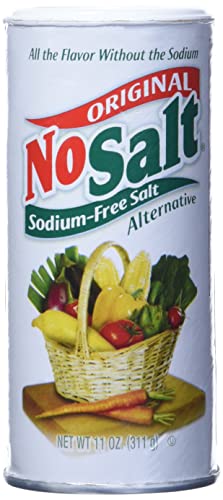
NoSalt is a sodium-free salt alternative with 640 mg of potassium per ¼ teaspoon, sold in an 11 oz canister.
Label Reality Check
- Active ingredients + form
- Potassium 640 mg (mainly as potassium chloride); sodium 0 mg per ¼ teaspoon
- Dose per serving
- ¼ teaspoon (1.3 g), used in place of salt
- Dose vs. research
- A full potassium replacement for salt; most trials used partial substitutes3
- Upper limit
- A high-potassium serving; people with kidney disease or on some blood pressure drugs need medical advice first1
- Purity testing
- No testing claim on the listing images we checked
- Other ingredients
- Potassium chloride, potassium bitartrate, adipic acid, silicon dioxide, mineral oil, fumaric acid
- Additives
- Minor (acidity regulators, anti-caking agent, mineral oil)
- Allergens & diet
- Not shown on the listing images we checked
- Safety flags
- High potassium per serving
Clinical Relevance
Like Nu-Salt, NoSalt cuts all the sodium from the salt you replace4, and its large canister makes it practical for everyday cooking.
Strengths
- No sodium
- Large 11 oz canister
- Low cost per serving
Limitations
- Several processing aids
- Bitter if overused
- Results in cooking are mixed
Practical Details
Use it in place of salt in cooking and baking, starting with less than you would use of regular salt.
Best For / Not For
Best forpeople who cook at home often and want to cut sodium.
Not foranyone who wants a single-ingredient product.
Buyer Experience
Buyers most often say it is a good salt substitute for low-sodium diets and works in baking.
Opinions on taste are mixed (bitter if you use too much), and some say it doesn’t behave like salt in every recipe.
vs. Nu-Salt
NoSalt comes in a larger canister at a lower cost per serving; Nu-Salt has no other ingredients.
Nutritionist’s Note
In recipes where salt does a job, such as bread dough, swap only part of the salt so the texture stays the same.
Verdict: A practical sodium-free salt for people who cook a lot.
#6Best Low-Dose Capsule
6. Swanson Potassium Gluconate 99 mg

BFN Score8.2/10
$$$Budget250 servings1 capsule per serving
Strongest atDose & safetyWeakest atEvidence fit
Swanson gives 99 mg of potassium as potassium gluconate in one capsule, with 250 capsules per bottle.
Label Reality Check
- Active ingredients + form
- Potassium 99 mg (as potassium gluconate)
- Dose per serving
- 1 capsule a day
- Dose vs. research
- Far below the 1,173 to 4,692 mg a day used in blood pressure trials1
- Upper limit
- A low dose; people with kidney disease or on some blood pressure drugs still need medical advice first1
- Purity testing
- Brand states third-party testing; made in an NSF- and UL-certified GMP facility
- Other ingredients
- Rice flour, gelatin (capsule), magnesium stearate, silica
- Additives
- Minor (common capsule fillers)
- Allergens & diet
- Gelatin capsule; not vegetarian
- Safety flags
- None beyond the usual kidney and medication cautions
Clinical Relevance
Gluconate is well absorbed1, but 99 mg is a small top-up; on its own it is unlikely to change blood pressure much1.
Strengths
- Fixed, low dose
- 250 capsules
- Well-absorbed form
Limitations
- Far below trial doses
- Gelatin capsule
- Does not lower sodium
Practical Details
Take 1 capsule a day with water.
Best For / Not For
Best forpeople who want a small, measured potassium top-up.
Not foranyone hoping a pill will lower blood pressure by itself.
Buyer Experience
Buyers most often say the capsules are easy to swallow and effective, and several say they help with cramps.
We found no repeated complaints.
vs. Nutricost Potassium Chloride Powder
Swanson needs no measuring and gives a smaller, fixed dose, while Nutricost gives much more potassium per serving for less.
Nutritionist’s Note
A capsule won’t make up for a salty diet; pair it with less salt and more potassium-rich foods.
Verdict: A simple low-dose capsule, best seen as a top-up rather than a treatment.
Products We Didn’t Recommend
- Life Enhancement High Potency Potassium (1,020 mg): far too much potassium per serving to take without medical supervision, especially with blood pressure drugs1.
- Nature’s Craft Potassium Gummies: 99 mg of potassium with 3 g of added sugar per 2 gummies.
Products We Considered
- Nature’s Bounty Potassium Gluconate 99 mg: a popular low-dose pill, very close to Swanson in our scoring.
- Best Naturals Potassium Gluconate: a low-cost 99 mg tablet; buyers often report crumbling tablets.
- Micro Ingredients Potassium Citrate Capsules and Dr. Murray’s Potassium: newer products with a small review base.
- Morton Salt Substitute: sodium-free; we kept one product per brand and chose Morton Lite Salt.
- Potassium citrate powders: covered in our best potassium citrate supplements.
Evidence Scorecard
| Question | What the research shows | Evidence level |
|---|---|---|
| Do salt substitutes lower blood pressure? | Cochrane review of 20 trials: −4.76/−2.43 mmHg vs. regular salt3 | Moderate |
| Do salt substitutes prevent strokes? | 20,995 older adults in rural China: fewer strokes, heart events and deaths with 25% potassium salt2 | Strong (one large trial plus meta-analysis4) |
| Do potassium pills lower blood pressure? | 25 trials: −4.48/−2.96 mmHg at 1,173–4,692 mg a day; 6 high-quality trials: no significant change1 | Mixed |
| Do salt substitutes raise blood potassium? | Slight average rise of 0.12 mmol/L in 6 trials3 | Moderate |
| Is one potassium form best for blood pressure? | Most trials used potassium chloride1; few compare forms | Limited |
Salt Substitute or Potassium Pill?
| Salt substitute | Potassium pill or powder | |
|---|---|---|
| Lowers sodium | Yes | No |
| Adds potassium | Yes | Yes |
| Outcome trials | Strokes, heart events, deaths24 | Blood pressure only1 |
| Typical potassium | 440–2,800 mg per tsp1 | 99 mg per pill1 |
| Main caution | Medicines and kidneys1 | Medicines and kidneys1 |
The best potassium product for blood pressure is usually the one that also replaces your salt: you get less sodium and more potassium from a habit you already have.
How Much Potassium Do You Need?
| Group | Adequate Intake (all sources) | Average US intake from food |
|---|---|---|
| Men 19+ | 3,400 mg1 | About 3,016 mg1 |
| Women 19+ | 2,600 mg1 | About 2,320 mg1 |
There is no upper limit for potassium for healthy people with normal kidney function, because the kidneys remove the extra1.
Food First
| Food | Potassium |
|---|---|
| Dried apricots, ½ cup | 755 mg1 |
| Lentils, cooked, 1 cup | 731 mg1 |
| Potato, baked, 1 medium | 610 mg1 |
| Banana, 1 medium | 422 mg1 |
One medium banana gives about four times the potassium of a 99 mg pill1.
Safety, Side Effects & Drug Interactions
Too much potassium in the blood (hyperkalemia) can cause muscle weakness and heart palpitations, and the risk is highest in people with kidney disease or on certain drugs1.
| Medication or condition | Possible issue | What to do |
|---|---|---|
| ACE inhibitors and ARBs | Can raise potassium levels1 | Ask your doctor before any potassium product or salt substitute |
| Potassium-sparing diuretics (spironolactone, amiloride) | Can raise potassium levels1 | Do not add potassium unless your doctor advises it |
| Loop and thiazide diuretics | Can lower potassium levels1 | Ask your doctor about a blood test |
| Chronic kidney disease | Body may not clear extra potassium1 | Use only with medical advice |
| Heart failure, type 1 diabetes, adrenal insufficiency, liver disease | Higher risk of high potassium1 | Ask your doctor first |
How to Choose a Potassium Product for Blood Pressure
Salt Swap or Supplement
If you add salt to food, a salt substitute does more for blood pressure than a pill, because it cuts sodium too4. If you rarely use salt, a potassium powder or capsule is the simpler option.
Sodium per Serving
Compare sodium per ¼ teaspoon: half-salts keep some sodium, while sodium-free salts remove it all.
Potassium per Serving
Salt substitutes give hundreds of milligrams per ¼ teaspoon; pills usually give 99 mg1. More potassium means more benefit for most people, but more risk if you are on potassium-raising drugs1.
Other Ingredients
Single-ingredient potassium chloride is the cleanest choice; anti-caking agents and acidity regulators are minor.
Taste
Potassium chloride can taste bitter; products that keep some sodium usually taste more like regular salt.
Label Red Flags
- Gummies with added sugar
- High-dose pills (500 mg or more) sold without a warning about blood pressure drugs or kidney disease
- Claims that a supplement “treats” or “cures” high blood pressure
Important: These supplements are not intended to diagnose, treat, cure, or prevent any disease. Results vary by individual. If you have a health condition or take medications, check with your doctor before adding any new supplement to your routine.
Frequently Asked Questions
What is the best potassium supplement for blood pressure?
What is the best form of potassium for blood pressure?
Is potassium citrate or potassium chloride better for blood pressure?
Chloride has the most blood pressure data1. Citrate is a reasonable non-chloride option, but it has less direct evidence for blood pressure.
How much potassium should I take to lower blood pressure?
Trials that lowered blood pressure used about 1,173 to 4,692 mg a day, mostly from potassium chloride1. Most people should reach higher intakes through food and a salt substitute rather than high-dose pills, and only with a doctor’s advice if they take blood pressure medicine.
Are salt substitutes good for people over 60?
Can I take potassium if I’m on blood pressure medication?
Sometimes, but ask your doctor first. ACE inhibitors, ARBs and potassium-sparing diuretics can raise potassium levels, while loop and thiazide diuretics can lower them1, so the right choice depends on which drug you take.
Final Verdict
For high blood pressure, the best potassium product for most people is a salt substitute, and our top pick is LoSalt: it cuts sodium and adds potassium in one simple swap.
Choose Nutricost Potassium Chloride Powder if you want a supplement in the trial form, Morton Lite Salt for a low-cost half-salt, or Nu-Salt if you need zero sodium.
Before you switch, ask your doctor if you take blood pressure medicine or have kidney disease.
Sources & History
References
- NIH Office of Dietary Supplements. Potassium: Fact Sheet for Health Professionals
- Neal B, Wu Y, Feng X, et al. Effect of Salt Substitution on Cardiovascular Events and Death — New England Journal of Medicine, 2021
- Brand A, Visser ME, Schoonees A, Naude CE. Replacing salt with low-sodium salt substitutes (LSSS) for cardiovascular health in adults, children and pregnant women — Cochrane Database of Systematic Reviews, 2022
- Yin X, Rodgers A, Perkovic A, et al. Effects of salt substitutes on clinical outcomes: a systematic review and meta-analysis — Heart, 2022
Update history
- Rewritten: compared 14 potassium supplements and salt substitutes; added salt substitute evidence (SSaSS, Cochrane 2022, Heart 2022 meta-analysis), sodium and potassium per serving, a salt-vs-pill table and a drug-interaction table.