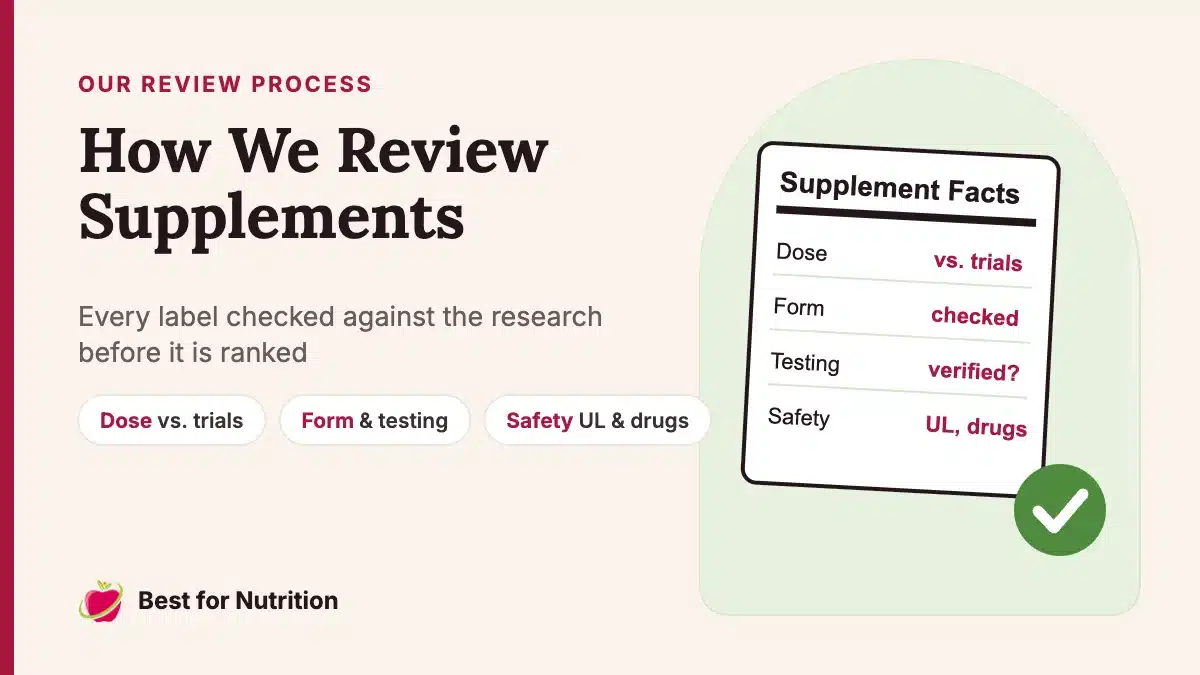
Every “Best” guide on Best for Nutrition answers one question: which product fits your situation, and why. This page shows exactly how we decide, what we check, and what we will never do.
These figures update automatically each time we publish or update a guide.
What We Do, and What We Don’t
✓ What we do
- Read every product’s Supplement or Drug Facts and “Other ingredients” panel
- Compare each dose with the doses used in human studies and with safe upper limits
- Check brands for recalls and FDA warning letters
- Note who sells the listing: the brand, an authorized reseller, the retailer or a third party
- Cite every health claim and list our sources at the end of each guide
✕ What we don’t do
- We don’t run our own laboratory tests
- We don’t claim to have taken a product unless a review says so
- We don’t accept payment to include, rank or remove a product
- We don’t use star ratings or review counts to score products
- We don’t currently have an independent medical review board
Our articles are educational and are not a substitute for advice from your doctor or pharmacist.
Our Process, Step by Step
Understand the question
We look at what people actually search for, such as “strongest”, “for seniors” or “with black seed oil”, so each guide answers the real question.
Check whether the ingredient works
Before comparing products, we grade the human evidence for the ingredient itself. Each guide includes a “Do You Actually Need” section and an Evidence Scorecard. If the evidence is weak, we say so.
Build a shortlist
We compare 10 to 20 labels and remove products that fail our safety and transparency gates (below).
Score each product on five criteria
Every shortlisted product is scored and the results are turned into a BFN Score. Every review shows where the product is strongest, where it is weakest, and any safety flags.
Keep it current
We review new research every quarter, act on safety alerts right away, and record every change in the update log at the bottom of each guide.
Products Must Pass These Gates First
Gates: fail one and a product is not ranked
- The label states the amount of each active ingredient. No proprietary blends that hide doses.
- Doses stay at or below the Tolerable Upper Intake Level. The only exception is a dose that matches a major clinical trial and is recommended by an expert guideline, and we always say when it should be used only under a doctor’s care.
- No recall or FDA warning letter for that product line in the past three years.
- No claims to cure or treat disease on the label or listing.
Products that fail are listed under “Products We Didn’t Recommend” when readers are likely to ask about them, with the reason.
How We Score: Five Weighted Criteria
Evidence fit
Is the form and amount of each active ingredient supported by human research for the purpose of the guide?
Dose & safety
How the daily dose compares with studies and upper limits, plus drug interactions, groups who should avoid it, and side effects of that form.
Quality & trust
Independent certification (USP, NSF, Informed Choice) scores highest. Recalls, missing key amounts or a third-party seller lower the score.
Purity & additives
Flagged additives, allergens and dietary fit (vegan, gluten-free), based on our additive policy below.
Value & practicality
Cost per day at the label dose compared with the other products in the guide, plus pills per day, format and taste.
Each criterion is rated from 1 to 5. We take the weighted average, then place it on a relative scale within the guide: the top product receives 9.6/10, the lowest 8.2/10, and the rest fall proportionally in between. Because every ranked product already passed our gates, even 8.2 means “a reasonable choice for some people”. Scores can tie; when they do, evidence fit decides the order, then dose and safety. Commission never breaks a tie.
Worked example: Best Oil of Oregano Supplements
| Criterion (weight) | Gaia Herbs Oil of Oregano | Natural Factors Oil of Oregano |
|---|---|---|
| Evidence fit (25%) | 3.0 | 2.5 |
| Dose & safety (25%) | 4.0 – 460 mg/day, close to the studied 600 mg | 2.0 – 30 mg/day |
| Quality & trust (20%) | 4.0 – carvacrol amount stated; brand reports independent testing | 3.5 – carvacrol stated, no named lab |
| Purity & additives (15%) | 4.5 – vegan, clean | 4.5 – clean |
| Value & practicality (15%) | 3.0 – highest cost per day | 3.5 – very cheap, strong taste |
| Weighted average | 3.68 → BFN Score 9.6 (top of guide) | 3.03 → BFN Score 8.2 (lowest in guide) |
See the full guide: Best Oil of Oregano Supplements.
How We Grade Evidence
| Level | What it means |
|---|---|
| Strong | Consistent results from large randomized trials, systematic reviews or clinical guidelines |
| Moderate | Several good trials point the same way, but with limits in size, length or consistency |
| Limited | Small, short or uncontrolled human studies |
| Insufficient | Mostly lab or animal research; not yet shown in people |
| Not supported | Good trials found no benefit |
We give the most weight to clinical guidelines and systematic reviews, then randomized trials, then smaller studies. Lab and animal studies are described as such. Brand marketing and customer reviews are never used as evidence that a supplement works.
How We Treat Additives
| Tier | Examples | Effect on score |
|---|---|---|
| Clean | Cellulose, rice flour, vegetable capsules, silicon dioxide, magnesium stearate | None. There is no good evidence these cause harm at supplement amounts. |
| Note | Major allergens, gelatin, added sugar or sugar alcohols in gummies, hidden caffeine, kelp | Flagged for the people affected; lowers the score when the guide targets that group |
| Flag | Synthetic dyes (for example FD&C Red No. 40), titanium dioxide, partially hydrogenated oils, talc, proprietary blends | Lowers the purity score; we always explain why and cite the source |
We avoid scare words like “toxic” or “chemicals”. Our aim is to tell you what an ingredient does, who should avoid it, and how strong the evidence is.
How We Show Cost
Prices change daily, so we don’t print them. Each product gets a cost tier ($, $$ or $$$) based on its cost per day at the label dose on the date we checked. The exact ranges are shown under each guide’s comparison table, because a fair price for melatonin is very different from a fair price for an eye vitamin.
How We Keep Guides Up to Date
- Every quarter: we search for new systematic reviews, major trials, updated guidelines and safety actions for every ingredient in our guides.
- Right away: recalls, FDA warnings or additive bans that affect a product we recommend.
- At each update: we recheck labels, sellers and cost tiers, and record what changed, including any change in ranking, in the update log.
If you spot a label change or an error, please contact us. We review every report and correct mistakes openly in the update log.
Our Authors
Each article shows its author, the date it was last updated, and what changed.
How We Make Money
Best for Nutrition is reader-supported. When you buy through links on our site, we may earn an affiliate commission, including as an Amazon Associate and through brand affiliate programs, at no extra cost to you. Commissions never decide which products we include or how they rank. Read our full disclosure statement.
Safety First
Supplements and over-the-counter medicines can interact with prescriptions and are not right for everyone, especially during pregnancy or breastfeeding, before surgery, for adults 65 and older, or if you have kidney, liver or heart conditions. Every guide includes safety flags and a safety section, but please talk to your doctor or pharmacist before starting something new.
Last updated: November 1, 2026.
As seen in


