
- Medical Overview
- Our Top Picks
- Comparison Table
- 1. PrimeMD 4-in-1 Calcium 1200mg, Vitamin D3 K2 5000IU — Best Overall
- 2. Nutricost Calcium Citrate Powder (Unflavored) — Best Budget
- 3. Bariatric Advantage Calcium Citrate Chewy Bites, Caramel — Best for Bariatric Patients
- 4. Nobi Nutrition Calcium Magnesium Zinc D3 — Best Multi-Mineral Formula
- 5. Swanson Calcium Citrate & Vitamin D — Best for Large Supply
- 6. Vital Nutrients Calcium (Citrate/Malate) — Best Low-Dose Option
- Evidence-Based Ingredients
- Buying Guide
- FAQ
- Final Thoughts
Struggling to remember your last calcium-rich meal, or noticing your doctor mention bone density during a checkup, is a common reason people start looking at calcium citrate supplements.
Unlike calcium carbonate, calcium citrate doesn’t require stomach acid for absorption, which makes it a common recommendation for older adults, people on acid-reducing medication, and those who’ve had bariatric surgery.
This guide compares six calcium citrate supplements across dose, form, and third-party testing, so you can match a product to your specific digestive needs and daily calcium goals.
Medical Overview
Calcium citrate is generally recommended for adults who need reliable absorption regardless of meal timing or stomach acid levels, including people over 50, those taking proton pump inhibitors, and post-bariatric surgery patients.
It’s less appropriate as a first choice for people who can absorb calcium carbonate normally and want a lower pill burden, since citrate forms typically require more capsules to hit the same elemental calcium dose.
People with a history of kidney stones, hypercalcemia, or those taking certain thyroid or antibiotic medications should talk to a healthcare provider before starting any calcium supplement, since timing and dosage can affect both safety and drug absorption.
Our Top Picks
Best Overall: PrimeMD 4-in-1 Calcium 1200mg with D3, K2 & B12 — Combines calcium, D3, K2, and B12 in one capsule for absorption and bone support.
Best Budget: Nutricost Calcium Citrate Powder — Pure calcium citrate powder offers flexible dosing at one of the lowest costs per serving.
Best for Bariatric Patients: Bariatric Advantage Calcium Citrate Chewy Bites — Chewable calcium citrate with D3 designed specifically for post-bariatric surgery patients needing gentle digestion.
Best Multi-Mineral Formula: Nobi Nutrition Calcium Magnesium Zinc D3 — Pairs calcium citrate with magnesium and zinc for combined bone, muscle, and immune support.
Best for Large Supply: Swanson Calcium Citrate & Vitamin D — High-dose calcium citrate and D3 tablets deliver a large 250-count supply at low per-serving cost.
Best Low-Dose Option: Vital Nutrients Calcium (Citrate/Malate) — Low-dose calcium citrate-malate blend suits those needing gentle, easily assimilated calcium without excess intake.
Comparison Table
| Rank | Product | Form | Price/Serving | Best For |
|---|---|---|---|---|
| 1 | PrimeMD 4-in-1 Calcium | Capsule | $0.40 | Adults wanting an all-in-one bone and heart support formula |
| 2 | Nutricost Calcium Citrate Powder | Powder | $0.16 | Budget-conscious buyers comfortable measuring their own scoop dose |
| 3 | Bariatric Advantage Chewy Bites | Chewable | $0.31 | Post-bariatric surgery patients who struggle to swallow pills |
| 4 | Nobi Nutrition Cal Mag Zinc D3 | Tablet | $0.43 | People wanting calcium paired with magnesium and zinc for muscle and sleep support |
| 5 | Swanson Calcium Citrate & Vitamin D | Tablet | $0.19 | Long-term users wanting a large, economical supply |
| 6 | Vital Nutrients Calcium (Citrate/Malate) | Capsule | $0.36 | Those needing a low, precise calcium dose alongside dietary intake |
1. PrimeMD 4-in-1 Calcium 1200mg, Vitamin D3 K2 5000IU — Best Overall

Price: $23.95 (as of September 5, 2026)
This 4-in-1 formula pairs 600mg of calcium citrate per serving with D3, K2, and B12 to support both absorption and directional distribution of calcium in the body.
Key Specs
- Active ingredient + form: Calcium citrate, 600mg elemental calcium per 2-capsule serving
- Dose per serving: 600mg calcium, 5,000 IU vitamin D3, 100mcg vitamin K2 (MK-7), 1,000mcg vitamin B12
- Certifications: Non-GMO, GMP certified
- Third-party tested: Not specified on label
- Servings per container: 60
- Price per serving: $0.40 (calculated manually, price as of September 5, 2026)
Clinical Relevance
Vitamin K2 activates matrix Gla-protein, a compound that helps direct calcium toward bone rather than soft tissue like arterial walls, which is why this formula pairs it with calcium and D3.
Vitamin D3 increases intestinal calcium absorption, while B12 supports nerve function, an area sometimes overlooked in general bone-health formulas.
Key Ingredients
- Calcium (as calcium citrate, 600mg): Supports bone mineral density and muscle function without requiring stomach acid for absorption.
- Vitamin K2 (as MK-7, 100mcg): Helps direct calcium toward bones and away from arterial tissue.
- Vitamin D3 (cholecalciferol, 5,000 IU): Increases the amount of calcium absorbed in the intestine.
Pros
- Combines four nutrients in one formula, reducing daily pill count
- Vegan capsule shell suitable for plant-based diets
- High reported reliability across thousands of Amazon reviews
Cons
- 5,000 IU of daily vitamin D3 is a high dose that some users found excessive
- Two-capsule serving may still cause mild constipation in sensitive users
Best Suited For
Adults who want one product to cover calcium, D3, K2, and B12 without juggling multiple bottles.
Usage Recommendations
Take 2 capsules daily with a meal and a full glass of water; consistent use for at least 60 days is recommended for best results.
Customer Feedback
Buyers frequently mention improved bone density readings and appreciate that the combined formula reduces their overall pill count. Many describe the capsules as easy to swallow and note no stomach upset even with daily use over several months.
A smaller group reports constipation or bloating, and several buyers felt the 5,000 IU vitamin D3 dose was higher than they wanted, especially if already taking a separate D3 supplement.
Summary: A well-rounded, easy-to-take formula that earns its “Best Overall” badge through broad nutrient coverage and consistent user results.
Doctor’s Note
Vitamin K2 can interact with blood-thinning medications like warfarin, so anyone on anticoagulant therapy should consult their doctor before starting this supplement.
2. Nutricost Calcium Citrate Powder (Unflavored) — Best Budget
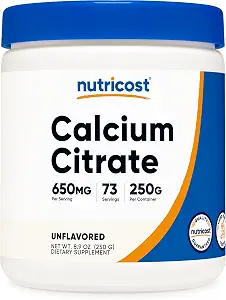
Price: $11.95 (as of September 5, 2026)
This unflavored powder delivers 650mg of calcium citrate per scoop with no other added ingredients, making it one of the simplest and least expensive ways to supplement calcium.
Key Specs
- Active ingredient + form: Calcium citrate powder, no fillers
- Dose per serving: 650mg elemental calcium per 1-scoop (3.5g) serving
- Certifications: Non-GMO, gluten-free, GMP compliant, FDA-registered facility
- Third-party tested: Not specified on label
- Servings per container: 73
- Price per serving: $0.16 (calculated manually, price as of September 5, 2026)
Clinical Relevance
As a single-ingredient citrate powder, this product allows precise, flexible dosing that can be adjusted to fit an individual’s dietary calcium gap rather than a fixed capsule amount.
Because it contains no added vitamin D, its absorption benefit depends on the user having adequate vitamin D status from diet, sunlight, or a separate supplement.
Key Ingredients
- Calcium (as calcium citrate, 650mg): Provides a stomach-acid-independent source of elemental calcium.
Pros
- Lowest price per serving among the products reviewed
- No fillers, binders, or added flavors
- Flexible dosing since it’s measured by scoop, not fixed capsule count
Cons
- Many buyers report the powder does not fully dissolve in water, leaving gritty residue
- No added vitamin D3, so absorption support depends on other dietary sources
Best Suited For
Budget-conscious buyers who want a flexible, no-frills calcium source and don’t mind mixing it into food or a smoothie rather than water.
Usage Recommendations
Mix one scoop (3.5g) into water, juice, or a smoothie once daily; blending into a thicker liquid like a smoothie improves texture compared to plain water.
Customer Feedback
Reviewers consistently describe the powder as tasteless, which makes it easy to mix into smoothies or other beverages without altering flavor. Several also highlight the low cost per serving as a major advantage over capsule-based calcium products.
The most common complaint is poor solubility in water, with multiple buyers describing a gritty texture that settles at the bottom of the glass rather than dissolving fully.
Summary: An affordable, no-frills calcium citrate option best mixed into smoothies rather than plain water for the smoothest texture.
Doctor’s Note
Since this product contains no vitamin D3, individuals with known vitamin D deficiency should pair it with a separate D3 supplement or ensure adequate dietary intake for optimal absorption.
3. Bariatric Advantage Calcium Citrate Chewy Bites, Caramel — Best for Bariatric Patients

Price: $18.55 (as of September 5, 2026)
Formulated specifically for post-bariatric surgery patients, these caramel chews deliver 250mg of calcium citrate with vitamin D3 in a sugar-free, chewable format that doesn’t require swallowing pills.
Key Specs
- Active ingredient + form: Calcium citrate chewable, caramel flavor
- Dose per serving: 250mg elemental calcium, 125 IU vitamin D3 per chew
- Certifications: Sugar-free, Kosher
- Third-party tested: Not specified on label
- Servings per container: 60
- Price per serving: $0.31 (calculated manually, price as of September 5, 2026)
Clinical Relevance
Bariatric surgery reduces the stomach’s acid-producing surface area, which impairs absorption of calcium carbonate; calcium citrate does not depend on stomach acid, making it the clinically preferred form for this population.
The chewable, sugar-free format also addresses a common post-surgical need: nutrient delivery that doesn’t require large pill swallowing or added sugar intake.
Key Ingredients
- Calcium (as calcium citrate, 250mg): Absorbed independently of stomach acid, suiting reduced-acid post-surgical stomachs.
- Vitamin D3 (125 IU): Supports calcium absorption at the intestinal level.
Pros
- Sugar-free and individually wrapped for portability
- Chewable format avoids swallowing large pills after surgery
- High praise for taste, often compared to soft caramel candy
Cons
- 250mg per chew means multiple chews are needed to reach typical bariatric calcium targets
- Some batches reported as harder or waxier than expected texture
Best Suited For
Post-bariatric surgery patients who need calcium citrate specifically and prefer a chewable format over capsules or tablets.
Usage Recommendations
Follow your bariatric care team’s specific calcium schedule, as most post-surgical patients need multiple chews spread throughout the day rather than one single dose; do not exceed the recommended daily amount without medical guidance.
Customer Feedback
Reviewers frequently praise the caramel flavor, describing it as tasting like a treat rather than a supplement, which makes daily adherence easier for many bariatric patients. Buyers also value the calcium content and sugar-free formulation for long-term post-surgical use.
Some users found the texture inconsistent between batches, describing it as harder or waxier than expected, and a smaller group reported gas or digestive discomfort with regular use.
Summary: A palatable, purpose-built calcium citrate chew that makes post-bariatric calcium supplementation easier to stick with long-term.
Doctor’s Note
Bariatric patients typically require more total daily calcium citrate than the general population; follow your surgeon’s or dietitian’s specific dosing schedule rather than standard label directions.
4. Nobi Nutrition Calcium Magnesium Zinc D3 — Best Multi-Mineral Formula

Price: $12.99 (as of September 5, 2026)
This 4-in-1 tablet combines calcium (as a carbonate/citrate blend) with magnesium and zinc, targeting users who want broader mineral support beyond calcium alone.
Key Specs
- Active ingredient + form: Calcium (as calcium carbonate, calcium citrate), magnesium (oxide, citrate, glycinate, malate), zinc picolinate
- Dose per serving: 1,000mg calcium, 250mg magnesium, 10mg zinc, 25mcg (1,000 IU) vitamin D3 per 3-tablet serving
- Certifications: GMP certified
- Third-party tested: Not specified on label
- Servings per container: 30
- Price per serving: $0.43 (calculated manually, price as of September 5, 2026)
Clinical Relevance
Magnesium works alongside calcium and vitamin D in bone metabolism, and several forms used here, including glycinate and citrate, are chosen for higher bioavailability than magnesium oxide alone.
Because this formula blends calcium carbonate with calcium citrate rather than using citrate exclusively, some of the stomach-acid independence associated with pure citrate forms is reduced.
Key Ingredients
- Calcium (carbonate/citrate blend, 1,000mg): Supports bone density and muscle contraction.
- Magnesium (multiple forms, 250mg): Supports muscle relaxation and may aid sleep quality.
- Zinc (as picolinate, 10mg): Supports immune function and wound healing.
Pros
- Combines three key minerals plus D3 in one tablet
- Multiple bioavailable magnesium forms used instead of magnesium oxide alone
- Widely reported to help with sleep and muscle cramps
Cons
- Blend includes calcium carbonate, not pure calcium citrate, reducing the stomach-acid-independent advantage
- Several buyers felt the elemental magnesium content was lower than expected relative to marketing claims
Best Suited For
Users who want calcium paired with magnesium and zinc for combined bone, muscle, and sleep support rather than a pure calcium citrate product.
Usage Recommendations
Take 3 tablets daily; some users split the dose, taking tablets earlier in the day and in the evening to support sleep-related magnesium benefits.
Customer Feedback
Many buyers report improved sleep quality and reduced nighttime muscle cramps after adding this supplement to their routine, often noting the effect within a few weeks of consistent use. The multi-mineral combination is frequently cited as a convenient way to cover several nutrient gaps in one tablet.
A notable subset of reviewers felt the elemental magnesium content was overstated relative to what the label implied, and some described the product’s marketing as misleading on this point.
Summary: A convenient multi-mineral tablet best suited to those wanting calcium alongside magnesium and zinc rather than a pure citrate-only formula.
Doctor’s Note
Because this product also delivers meaningful magnesium and zinc, avoid stacking it with other multivitamins containing these same minerals, particularly if you have reduced kidney function, without checking with your doctor first.
5. Swanson Calcium Citrate & Vitamin D — Best for Large Supply

Price: $24.29 (as of September 5, 2026)
This 250-tablet bottle delivers 630mg of calcium citrate with vitamin D3 per two-tablet serving, giving long-term users a large supply at a low cost per serving.
Key Specs
- Active ingredient + form: Calcium citrate tablet with vitamin D3
- Dose per serving: 630mg elemental calcium, 12.5mcg (500 IU) vitamin D3 per 2-tablet serving
- Certifications: Non-GMO, gluten-free, GMP certified facility, third-party purity and potency testing
- Third-party tested: Yes
- Servings per container: 125
- Price per serving: $0.19 (calculated manually, price as of September 5, 2026)
Clinical Relevance
At 630mg of calcium citrate per serving alongside D3, this formula provides a clinically relevant dose for adults managing dietary calcium gaps, particularly those recovering from conditions affecting calcium regulation, such as parathyroid surgery.
Third-party purity and potency testing adds a layer of quality assurance not confirmed on several other products in this comparison.
Key Ingredients
- Calcium (as calcium citrate, 630mg): Supports bone density without requiring stomach acid for absorption.
- Vitamin D3 (cholecalciferol, 12.5mcg): Enhances intestinal calcium absorption.
Pros
- Third-party tested for purity and potency
- Large 250-count supply lowers long-term cost per serving
- Long-standing brand history with GMP-certified manufacturing
Cons
- Requires 4 tablets daily to reach the full labeled calcium and D3 dose
- Some buyers noted inconsistent bottle sizing between orders despite identical tablet counts
Best Suited For
Long-term users who want a large, cost-effective calcium citrate supply backed by third-party testing.
Usage Recommendations
Take 2 tablets twice daily with water, for a total of 4 tablets per day to reach the full labeled dose; consistent daily timing helps maintain steady calcium levels.
Customer Feedback
Long-time calcium users describe this product as a reliable, trusted option, particularly appreciating the third-party testing and the easy-to-swallow tablet size. Several buyers specifically use it after thyroid or parathyroid procedures on their doctor’s recommendation.
A few reviewers found the tablets slightly large, and some noted that bottle size varied between orders even though the tablet count and price stayed the same.
Summary: A trusted, third-party-tested calcium citrate tablet that rewards long-term users with a low cost per serving.
Doctor’s Note
Calcium can interfere with the absorption of thyroid medication and certain antibiotics; separate doses by at least four hours if you take either of these medications.
6. Vital Nutrients Calcium (Citrate/Malate) — Best Low-Dose Option

Price: $17.99 (as of September 5, 2026)
This hypoallergenic formula uses a calcium citrate-malate blend at a lower 300mg dose per serving, designed for people who need a precise, gentle top-up rather than a high-dose supplement.
Key Specs
- Active ingredient + form: Calcium (50% calcium citrate-malate, 50% di-calcium malate)
- Dose per serving: 300mg elemental calcium per 2-capsule serving
- Certifications: Non-GMO, vegan, hypoallergenic, third-party independent lab tested
- Third-party tested: Yes
- Servings per container: 50
- Price per serving: $0.36 (calculated manually, price as of September 5, 2026)
Clinical Relevance
Calcium citrate-malate is a well-absorbed form often used in research on bone density in postmenopausal women, and its lower per-serving dose suits people who already get partial calcium from diet and need only a modest supplement top-up.
The absence of added fillers, binders, or artificial coatings also makes this a suitable option for people with multiple supplement sensitivities.
Key Ingredients
- Calcium (citrate-malate/di-calcium malate blend, 300mg): Offers a well-absorbed, gentler calcium dose suited to smaller supplemental needs.
Pros
- Third-party independent lab tested for purity and potency
- Free from artificial fillers, binders, coatings, and colors
- Lower dose allows precise stacking with dietary calcium intake
Cons
- 300mg per serving is too low to serve as a sole calcium source for those with higher needs, such as diagnosed osteoporosis
- No added vitamin D3, so absorption support depends on other sources
Best Suited For
People who already get a significant portion of their calcium from diet and want a precise, lower-dose supplement to fill the remaining gap.
Usage Recommendations
Take 2 capsules daily, or adjust to 1 capsule with specific meals to offset high-oxalate foods like spinach or beets that reduce calcium absorption.
Customer Feedback
Buyers specifically searching for a lower-dose calcium citrate option frequently praise this product for filling that niche, often mentioning it pairs well with a calcium-conscious diet. Many also highlight the easy-to-swallow capsule and lack of digestive upset compared to other calcium citrate products they’ve tried.
A smaller number of reviewers note that the 300mg dose is too low for anyone needing a full daily calcium supplement without significant dietary calcium already in place.
Summary: A gentle, precisely dosed calcium citrate-malate capsule best used to top up dietary calcium rather than replace it entirely.
Doctor’s Note
This lower 300mg dose is not sufficient as a standalone calcium source for people with diagnosed osteoporosis or significant dietary calcium deficits; discuss your total daily calcium target with your doctor before relying on this product alone.
Evidence-Based Ingredients
Calcium Citrate
Calcium citrate has been studied in clinical trials for bone density maintenance, particularly in postmenopausal women, and is well established as absorbing effectively regardless of stomach acid levels.
This distinguishes it from calcium carbonate, which relies on stomach acid and traditional use in general bone-health formulations.
Vitamin D3
Vitamin D3’s role in increasing intestinal calcium absorption is supported by strong clinical evidence, including randomized controlled trials on bone mineral density and fracture risk reduction.
Most calcium formulas pair it with calcium specifically because low vitamin D status significantly reduces the benefit of any calcium supplement.
Vitamin K2
Vitamin K2’s role in directing calcium toward bone via matrix Gla-protein activation has emerging clinical evidence, particularly for the MK-7 form, though research is less extensive than for vitamin D3.
Traditional use in Japanese fermented soy foods (natto) predates its use in modern supplement formulas.
Magnesium
Magnesium’s role in bone metabolism and muscle relaxation is supported by mechanistic studies and observational research, with more limited randomized controlled trial data specifically on calcium co-supplementation outcomes.
Note: The ingredients in our top picks have a mix of traditional use, emerging evidence, and strong clinical backing for supporting calcium absorption and bone health. They are not treatments for osteoporosis or any other condition and should not replace medical care.
Buying Guide
What Are Calcium Citrate Supplements?
Calcium citrate supplements provide elemental calcium bound to citric acid, a form that the body can absorb without needing stomach acid, unlike calcium carbonate.
This makes calcium citrate a common recommendation for older adults, people taking acid-reducing medications, and those who have had bariatric or gastric surgery.
Common Signs You May Need Calcium Citrate Support
- Diagnosed low bone density or osteoporosis risk factors
- History of bariatric or gastric bypass surgery
- Long-term use of proton pump inhibitors or other acid-reducing medications
- Limited dietary calcium intake from dairy or fortified foods
- Age over 50, when calcium absorption naturally declines
- Recent parathyroid or thyroid surgery affecting calcium regulation
Key Ingredients to Look For
- Calcium citrate: Absorbed independently of stomach acid, best form for those with reduced digestive acid
- Vitamin D3: Increases intestinal calcium absorption; look for at least 400–1,000 IU per serving
- Vitamin K2 (MK-7): Helps direct calcium toward bone rather than soft tissue
- Magnesium: Supports bone metabolism when paired with calcium in balanced ratios
How to Choose
Consider the elemental calcium dose per serving relative to your dietary intake, since most people need 1,000–1,200mg total daily calcium depending on age and sex.
Check whether the product is third-party tested for purity and potency, since not all supplements confirm this on the label.
Factor in pill burden and format, choosing chewable or powder forms if you struggle with swallowing capsules or tablets.
Compare price per serving rather than sticker price, since serving sizes vary widely between two- and four-capsule daily doses.
Who May Benefit
Postmenopausal women managing bone density decline, older adults with reduced stomach acid production, people on long-term acid-reducing medication, and post-bariatric surgery patients needing acid-independent calcium absorption.
Safety and Side Effects
Calcium citrate can interfere with the absorption of certain thyroid medications, antibiotics (such as tetracyclines and fluoroquinolones), and iron supplements, so spacing doses by several hours is often recommended.
People with a history of kidney stones or hypercalcemia should consult a doctor before supplementing, since excess calcium intake can worsen these conditions.
Common side effects include mild constipation, bloating, or gas, particularly at higher doses or when starting a new formula.
What Results Can You Expect?
Bone density changes from calcium supplementation typically take months to years to reflect in a DEXA scan, and calcium alone will not reverse existing osteoporosis without additional medical treatment.
Digestive comfort improvements, such as reduced bloating compared to calcium carbonate, are often noticeable within the first few weeks of switching to a citrate form.
Lifestyle Tips
- Pair calcium intake with weight-bearing exercise to support bone density
- Space calcium doses away from high-oxalate foods like spinach and beets for better absorption
- Get regular sun exposure or monitor vitamin D levels to support calcium absorption
- Avoid taking calcium at the same time as iron supplements or certain medications
- Spread total daily calcium across two or more smaller doses rather than one large dose for better absorption
FAQ
Is calcium citrate better than calcium carbonate?
Calcium citrate absorbs well regardless of stomach acid levels, making it preferable for older adults, people on acid-reducing medications, and bariatric surgery patients, while calcium carbonate requires stomach acid and is typically less expensive per milligram of calcium.
Can I take calcium citrate on an empty stomach?
Yes, calcium citrate can be taken with or without food since it doesn’t depend on stomach acid for absorption, unlike calcium carbonate, which should be taken with meals.
How much calcium citrate should I take daily?
Most adults need 1,000–1,200mg of total daily elemental calcium including diet, so supplement dosing should account for dietary intake rather than assuming the full label amount is needed on top of food sources.
Does calcium citrate cause constipation?
Calcium citrate causes less constipation than calcium carbonate for most people, though some users still report mild digestive changes, especially at higher doses or when starting a new supplement.
Can I take calcium citrate with magnesium?
Yes, calcium and magnesium are commonly taken together since magnesium supports bone metabolism, though very high combined doses may cause digestive upset in sensitive individuals.
Does calcium citrate interact with any medications?
Calcium can reduce the absorption of thyroid medications, certain antibiotics, and iron supplements, so these should typically be taken at least four hours apart from calcium; consult your doctor or pharmacist about your specific medications before starting.
Final Thoughts
For most adults, the PrimeMD 4-in-1 Calcium stands out as the top pick, combining calcium citrate with D3, K2, and B12 in a single, well-reviewed formula.
For those managing calcium after bariatric surgery specifically, the Bariatric Advantage Calcium Citrate Chewy Bites offer a purpose-built, easy-to-tolerate alternative to standard capsules.
Anyone with a history of kidney stones, hypercalcemia, or who takes thyroid medication, blood thinners, or certain antibiotics should speak with a doctor before starting any calcium citrate supplement rather than choosing based on reviews alone.