Written byAnju Mobin, B.ScNutritionist · B.Sc. Clinical Nutrition & DieteticsLast updatedProducts compared6 picks from 16 productsHow we review →
We may earn a commission when you buy through our links, at no extra cost to you. As an Amazon Associate we earn from qualifying purchases. How we make money
At a Glance
- Best Overall Nature Made Kids First Vitamin C Gummies – 125 mg per gummy, USP Verified, for ages 4 and up.Review ↓
- Best Value Amazon Basics Kids’ Vitamin C Gummies – 125 mg per gummy with just 1 g of sugar, for ages 2 and up.Review ↓
- Best Liquid Drops MaryRuth’s Kids Vitamin C Drops – 45 mg from organic acerola, no added sugar.Review ↓
- Best Vegan Gummy Nordic Naturals Kids Vitamin C Gummies – 250 mg per two pectin gummies.Review ↓
- Best for Toddlers ChildLife Liquid Vitamin C – dosing by age, from 1/4 teaspoon up.Review ↓
- Best Liposomal Beekeeper’s Naturals Kids Liposomal Vitamin C – 500 mg in a squeeze packet with propolis and elderberry, for ages 4 and up.Review ↓
The Short Answer: Most children get enough vitamin C from food, and kids who need a supplement need far less than adults. Our top pick, Nature Made Kids First Vitamin C Gummies, gives 125 mg per gummy and is the only kids’ vitamin C we found with USP verification.
On this page
- Does Your Child Need Vitamin C?
- Find Your Match
- Vitamin C for Kids Compared
- The 6 Best Vitamin C Supplements for Kids, Reviewed
- Products We Considered but Didn’t Include
- Evidence Scorecard
- How to Give Vitamin C to Kids
- What to Expect and When
- Safety, Side Effects & Drug Interactions
- Food First: Where Kids Get Vitamin C
- How to Choose a Vitamin C Supplement for Kids
- Frequently Asked Questions
- Final Verdict
For toddlers aged 2–3, choose Amazon Basics Kids’ Vitamin C Gummies, which are labeled from age 2 and have only 1 g of sugar. Liposomal vitamin C has not been studied in children, so we don’t recommend it over regular vitamin C for kids4.
We compared 16 vitamin C products sold for children on dose by age, form, testing, sugar, other ingredients, cost per day and parent feedback. Every product is ranked by its BFN Score, a relative score within this guide. See our review process for how we score.
Does Your Child Need Vitamin C?
Children need much less vitamin C than adults. The RDA is 15 mg a day for ages 1–3, 25 mg for ages 4–8 and 45 mg for ages 9–131. Half a cup of orange juice or a few strawberries covers that for most kids.
A supplement makes more sense for very picky eaters who rarely eat fruit or vegetables, children on restricted diets, or kids whose doctor has found low intake. Children who took vitamin C regularly had colds that were about 14% shorter, but it didn’t lower how often they caught colds3.
Upper Limits by Age
| Age | RDA | Upper Limit (UL) |
|---|---|---|
| 1–3 years | 15 mg | 400 mg |
| 4–8 years | 25 mg | 650 mg |
| 9–13 years | 45 mg | 1,200 mg |
| 14–18 years | 65–75 mg | 1,800 mg |
Source: NIH Office of Dietary Supplements1. The UL includes vitamin C from food and supplements. No UL is set for babies under 1 year.
Who Should Skip It or Ask First
- Babies under 1 year: ask your pediatrician before giving any vitamin C supplement.
- Children with hemochromatosis or other iron disorders: high doses could worsen iron overload1.
- Children with kidney problems: ask your doctor first.
- Children with a bee or pollen allergy: avoid products with propolis or honey.
- Children under 4: gummies can be a choking hazard; follow the age on the label.
Find Your Match
| If your child… | Consider | Why |
|---|---|---|
| Is 4 or older and likes gummies | Nature Made | USP Verified, 125 mg |
| Is 2–3 and can chew gummies | Amazon Basics | Labeled from age 2, 1 g sugar |
| Won’t chew or swallow anything | MaryRuth’s | Drops you can mix into a drink |
| Is vegan or avoids gelatin | Nordic Naturals | Pectin gummies |
| Is a toddler who needs a measured liquid | ChildLife | Age-based doses |
| Is 4+ and you want a liposomal blend | Beekeeper’s Naturals | 500 mg with propolis and elderberry |
| Eats fruit most days | Probably no supplement | Food usually covers the RDA1 |
Vitamin C for Kids Compared
Scroll sideways to see every column →
| # | Product | Form | Vitamin C per Serving | Ages | Share of UL (ages 4–8) | Added Sugar | Purity Testing | Diet | Cost |
|---|---|---|---|---|---|---|---|---|---|
| 1 | Nature Made | Gummy | 125 mg | 4+ | 19% | 2 g | USP Verified | Contains gelatin | $$$ |
| 2 | Amazon Basics | Gummy | 125 mg | 2+ | 19% | 1 g | Not stated | Vegetarian (pectin) | $$$ |
| 3 | MaryRuth’s | Liquid drops | 45 mg (2 mL) | 4–13 | 7% | 0 g | Not stated | Vegan, organic | $$$ |
| 4 | Nordic Naturals | Gummy | 250 mg (2 gummies) | 4+ | 38% | 4 g | Not stated | Vegan | $$$ |
| 5 | ChildLife | Liquid | 250 mg (1 tsp, ages 1–3); 500 mg (2 tsp, ages 4+) | 6 months+ | 77% at 2 tsp | 2–4 g | Not stated | Contains fructose | $$$ |
| 6 | Beekeeper’s Naturals | Liposomal packet | 500 mg | 4+ | 77% | Contains honey | Not stated | Contains bee products | $$$ |
Cost per day at the label dose: $ = under $0.20, $$ = $0.20–$0.60, $$$ = over $0.60. Checked November 2026; prices change often.
The 6 Best Vitamin C Supplements for Kids, Reviewed
#1Best Overall
1. Nature Made Kids First Vitamin C Gummies

BFN Score9.6/10
$$$Budget110 servings (110 gummies)1 gummy per serving
Strongest atQuality & trustWeakest atPurity & additives
Nature Made gives 125 mg of vitamin C in one tangerine gummy for children 4 and older. It’s USP Verified, which means an independent lab checked that it contains what the label says.
Label Reality Check
- Active ingredient + form
- vitamin C as ascorbic acid and sodium ascorbate
- Dose per serving
- 1 gummy = 125 mg
- Dose vs. research
- Several times the RDA for ages 4–13, though below the 200 mg a day used in cold trials13
- % DV / Upper Limit
- 139% DV for children 4+; 19% of the 650 mg upper limit for ages 4–81
- Purity testing
- USP Verified
- Other ingredients
- sugar, glucose syrup, water, gelatin, citric acid, pectin, natural flavors, color added
- Additives
- Note – 2 g added sugar per gummy; added color
- Allergens & diet
- contains gelatin, so not vegetarian; gluten-free
- Safety flags
- Not for children under 4 (choking hazard)
Clinical Relevance
At 125 mg a day, your child gets well above the RDA without coming close to the upper limit, even with fruit and juice on top1. That margin matters more for kids than for adults.
Strengths
- USP Verified
- Low cost per day
- Moderate dose for children
Limitations
- Contains gelatin
- 2 g added sugar per gummy
- Gummies can harden after opening
Practical Details
Give 1 gummy a day. Keep the lid tightly closed and store the bottle out of reach, since kids may treat gummies like candy.
Best For / Not For
Best forchildren 4 and up who like gummies.
Not forvegetarian families, or children under 4.
Buyer Experience
Parents most often say their kids enjoy the taste and take them without a fight, and many describe them as not too sweet. Some have bought them for years, and several give them during cold season alongside a multivitamin. Parents also mention good value for a 110-day supply.
Texture splits opinion: more than half of parents who mention it say the gummies harden over time or melt while chewing. A few find them a little sour.
vs. Amazon Basics
Choose Nature Made for USP verification. Choose Amazon Basics for a younger child (2+) and less sugar.
Nutritionist’s Note
A gummy vitamin is still candy-like; brush teeth after, since sugar and acid stick to teeth.
Verdict: The best kids’ vitamin C for most families: a moderate, verified dose kids actually take.
#2Best Value
2. Amazon Basics Kids’ Vitamin C Gummies

BFN Score9.4/10
$$$Budget60 servings (60 gummies)1 gummy per serving
Strongest atValue & practicalityWeakest atQuality & trust
Amazon Basics gives 125 mg of vitamin C in one orange pectin gummy with 1 g of added sugar, the least sugar of any gummy we compared. It’s labeled for children 2 and up with adult supervision.
Label Reality Check
- Active ingredient + form
- vitamin C as ascorbic acid
- Dose per serving
- 1 gummy = 125 mg
- Dose vs. research
- Well above the RDA for ages 2–131
- % DV / Upper Limit
- 833% DV for ages 2–3; 31% of the 400 mg upper limit for ages 1–3, 19% of the 650 mg limit for ages 4–81
- Purity testing
- Not stated
- Other ingredients
- sucrose, glucose syrup, pectin, annatto extract (color), citric acid, natural flavors, sodium citrate
- Additives
- Note – annatto color; 1 g added sugar
- Allergens & diet
- vegetarian (pectin); gluten-free
- Safety flags
- Supervise children under 4; gummies can be a choking hazard
Clinical Relevance
For a 2- or 3-year-old, one gummy is over eight times the RDA but still under a third of the upper limit1. That’s plenty; there’s no need to give more.
Strengths
- Least sugar of the gummies
- Labeled from age 2
- Under $0.20 a day
Limitations
- No outside testing stated
- Only 60 gummies per bottle
- Annatto color
Practical Details
Give 1 gummy a day. For children under 4, cut it into small pieces and stay with them while they eat it.
Best For / Not For
Best fortoddlers 2 and up and budget-minded families.
Not forfamilies who want outside testing.
Buyer Experience
Taste is the most common topic, and most parents say their kids love the orange flavor and ask for it each morning. Parents also find the gummies soft and easy to chew, and several like that there’s only 1 g of sugar. One parent gives it to her 3-year-old with a multivitamin to help her absorb iron, and several adults take them too.
About half of parents who mention sugar wish it had none at all. A few find the gummies sticky.
vs. Nordic Naturals
Choose Amazon Basics for less sugar and a lower cost. Choose Nordic Naturals for a vegan gummy with organic sweeteners and a higher dose.
Nutritionist’s Note
Giving vitamin C with an iron-rich meal helps your child absorb more iron from plant foods such as beans and fortified cereal1.
Verdict: The best low-sugar, low-cost gummy, and the best gummy for toddlers.
#3Best Liquid Drops
3. MaryRuth’s Kids Vitamin C Drops

BFN Score9.1/10
$$$Mid-rangeabout 30 servings (2 oz)2 mL per serving
Strongest atDose & safetyWeakest atValue & practicality
MaryRuth’s gives 45 mg of vitamin C from organic acerola cherry in 2 mL of orange-vanilla liquid, for children 4 to 13. It has no added sugar and is the gentlest dose on our list.
Label Reality Check
- Active ingredient + form
- vitamin C from organic acerola fruit extract
- Dose per serving
- 2 mL = 45 mg
- Dose vs. research
- Meets the RDA for ages 9–13 and is almost twice the RDA for ages 4–81
- % DV / Upper Limit
- 50% DV for ages 4–13; 7% of the 650 mg upper limit for ages 4–81
- Purity testing
- Not stated
- Other ingredients
- organic vegetable glycerin, purified water, organic natural orange flavor, organic natural vanilla flavor
- Additives
- Clean
- Allergens & diet
- vegan; USDA Organic
- Safety flags
- None at this dose
Clinical Relevance
This is a top-up dose, not a high dose. For a child who eats some fruit, 45 mg is enough to cover any gap. The cold trials used at least 200 mg a day, so don’t expect this to shorten colds3.
Strengths
- No added sugar
- Organic, short ingredient list
- Can be mixed into food or drinks
Limitations
- Low dose per serving
- Higher cost per milligram
- Some kids dislike the taste
Practical Details
Give 2 mL a day by dropper, straight or mixed into juice, yogurt or a smoothie. Store in a cool place after opening.
Best For / Not For
Best forchildren who won’t chew gummies and families avoiding added sugar.
Not fortoddlers under 4, or parents looking for a higher dose.
Buyer Experience
Almost all parents who mention effectiveness are positive, and many say the dropper makes it easy to give the right amount. Parents like the organic ingredients and that there’s no added sugar, and several mix it into drinks or food. Some feel their kids get sick less often since starting it, which is personal experience rather than proof.
Taste is the main complaint: about one in six parents who mention it say their kids don’t like it, and one says it tastes like butter even in orange juice.
vs. ChildLife
Choose MaryRuth’s for no added sugar and a gentle dose. Choose ChildLife for toddlers under 4 or a higher dose.
Nutritionist’s Note
Mixing drops into a small amount of food, rather than a full cup, makes sure your child gets the whole dose.
Verdict: The best sugar-free liquid for kids who need only a little extra vitamin C.
#4Best Vegan Gummy
4. Nordic Naturals Kids Vitamin C Gummies

BFN Score9.0/10
$$$Mid-range30 servings (60 gummies)2 gummies per serving
Strongest atDose & safetyWeakest atPurity & additives
Nordic Naturals gives 250 mg of vitamin C in two vegan pectin gummies for children 4 and older. Color comes from fruit and vegetable juice, with no synthetic dyes.
Label Reality Check
- Active ingredient + form
- vitamin C as L-ascorbic acid
- Dose per serving
- 2 gummies = 250 mg
- % DV / Upper Limit
- 278% DV for children 4+; 38% of the 650 mg upper limit for ages 4–81
- Purity testing
- Not stated
- Other ingredients
- organic cane sugar, organic tapioca syrup, purified water, pectin, natural flavor, fruit and vegetable juice (color), sodium citrate
- Additives
- Note – 4 g added sugar per serving
- Allergens & diet
- vegan; no gluten or milk derivatives
- Safety flags
- Not for children under 4
Clinical Relevance
At 250 mg, this is the highest gummy dose on our list. One gummy (125 mg) is enough for most children; the full two-gummy serving suits older kids who eat little fruit.
Strengths
- Vegan pectin gummy
- No synthetic dyes
- Organic sweeteners
Limitations
- 4 g added sugar per serving
- Only 30 servings per bottle
- Higher cost per day than other gummies
Practical Details
Give 1 to 2 gummies a day. For a 4- to 8-year-old who eats fruit, one gummy is plenty.
Best For / Not For
Best forvegan families and older children.
Not forparents keeping sugar low, or children under 4.
Buyer Experience
Every parent who mentions enjoyment says their kids love these, and several like that they’re vegan and pork-free. Parents describe the tangy tangerine flavor as sweet but not too sweet and the texture as soft. One family has used them for over a year alongside a multivitamin.
Sugar splits opinion: about half of parents who mention it feel the sugar coating is too much. This product has fewer reviews than most on our list.
vs. Nature Made
Choose Nordic Naturals for a vegan gummy. Choose Nature Made for USP verification and less sugar per serving.
Nutritionist’s Note
If you give only one gummy a day, the bottle lasts two months and your child gets half the sugar.
Verdict: The best vegan gummy, best given one gummy at a time to younger kids.
#5Best for Toddlers
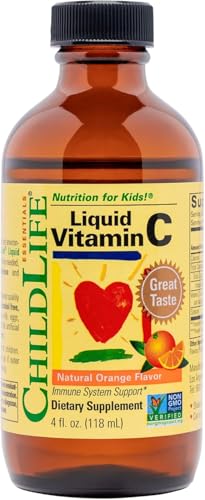
5. ChildLife Liquid Vitamin C
BFN Score8.9/10
$$$Mid-range24 servings for ages 1–3 (4 fl oz)1 teaspoon per serving (ages 1–3)
Strongest atEvidence fitWeakest atPurity & additives
ChildLife is an orange-flavored liquid with doses printed by age: 1/4 teaspoon for babies, 1 teaspoon for ages 1–3 and 2 teaspoons for ages 4 and up. It’s the only product here labeled for children under 2.
Label Reality Check
- Active ingredient + form
- vitamin C as sodium ascorbate and ascorbic acid
- Dose per serving
- 1/4 tsp = 63 mg (6–12 months); 1 tsp = 250 mg (ages 1–3); 2 tsp = 500 mg (ages 4+)
- Dose vs. research
- Well above the RDA at every age1
- % DV / Upper Limit
- 1 tsp is 63% of the 400 mg upper limit for ages 1–3; 2 tsp is 77% of the 650 mg limit for ages 4–81
- Purity testing
- Not stated
- Other ingredients
- purified water, fructose, vegetable glycerin, natural flavors, potassium sorbate (preservative), grapefruit seed extract
- Additives
- Note – fructose (2–4 g added sugar per serving) and a preservative
- Allergens & diet
- no gelatin; contains added fructose
- Safety flags
- The label doses use a large share of the upper limit; for babies, ask your pediatrician first
Clinical Relevance
The label doses are higher than most children need. Half the label dose (1/2 teaspoon, about 125 mg) is plenty for a toddler and leaves more room under the upper limit1. We counted the high label doses against its safety score.
Strengths
- Doses printed by age
- Easy to give to toddlers
- Low cost per bottle
Limitations
- Label doses are high for young children
- Added fructose
- Leaking caps reported; sold here by a third-party seller
Practical Details
Use a measuring syringe, not a kitchen spoon. Give it straight or mixed into a little juice. Keep the cap tight and the bottle upright.
Best For / Not For
Best fortoddlers who can’t chew gummies yet.
Not forfamilies avoiding added sugar, or parents who’d rather not adjust the label dose.
Buyer Experience
Most parents who mention effectiveness are positive, and many say even picky eaters like the orange flavor. Parents find it easy to give with a syringe, and one parent used it for her babies until they could chew gummies. Several say their kids ask for it if they forget.
Leaks are the most consistent complaint: every parent who mentions leakage reports a leaking or broken cap. Value opinions are mixed, with about a third of those who mention price feeling it isn’t worth it.
vs. MaryRuth’s
Choose ChildLife for toddlers and adjustable doses. Choose MaryRuth’s for no added sugar.
Nutritionist’s Note
For a toddler who eats some fruit, 1/2 teaspoon a day is enough; you don’t need the full label dose.
Verdict: The best option for toddlers, if you give less than the label dose.
#6Best Liposomal
6. Beekeeper’s Naturals Kids Liposomal Vitamin C

BFN Score8.2/10
$$$Premium12 servings (12 packets)1 packet per serving
Strongest atDose & safetyWeakest atValue & practicality
Beekeeper’s Naturals is the only liposomal vitamin C for kids we found in stock. Each mixed-berry squeeze packet has 500 mg of vitamin C plus vitamin D, propolis, elderberry and honey, for children 4 and older.
Label Reality Check
- Active ingredient + form
- liposomal vitamin C with vitamin D, bee propolis, elderberry and honey
- Dose per serving
- 1 packet = 500 mg vitamin C (amounts of the other ingredients weren’t shown in the product images we checked)
- Dose vs. research
- Far above the RDA for ages 4–131; liposomal vitamin C hasn’t been studied in children4
- % DV / Upper Limit
- 77% of the 650 mg upper limit for ages 4–8; 42% of the 1,200 mg limit for ages 9–131
- Purity testing
- Not stated
- Other ingredients
- not fully shown in the listing images; check the box
- Additives
- Note – contains honey
- Allergens & diet
- contains bee products (propolis, honey)
- Safety flags
- Not for children with bee or pollen allergies; not for children under 4; don’t combine with other vitamin C or vitamin D supplements without checking totals
Clinical Relevance
There are no studies of liposomal vitamin C in children, and adult studies show only higher blood levels, not fewer illnesses4. A 500 mg packet uses most of a young child’s upper limit, so it’s best kept for occasional use.
Strengths
- Only in-stock liposomal option for kids
- Single-serve packets
- No pills to chew or swallow
Limitations
- Highest cost per day on our list
- 500 mg is high for ages 4–8
- Many kids refuse the taste
Practical Details
Squeeze one packet into your child’s mouth or mix it into a little juice. Use it for a few days at a time rather than every day for younger children.
Best For / Not For
Best forolder children who want a squeeze packet and parents who prefer a liposomal form.
Not forchildren under 4, children with bee allergies, or daily use in ages 4–8.
Buyer Experience
Most parents who mention effectiveness are positive, and some start giving it when someone at school or a playdate is sick. Parents like the natural ingredients and how easy the packets are to use in a rush, and some give it daily through cold and flu season.
Taste and acceptance are the main problems: about half of parents who mention taste dislike it, describing it as very sweet or medicinal, and nearly two-thirds who discuss their child’s reaction say their child refused it. One parent wasn’t comfortable with some of the ingredients.
vs. Nature Made
Choose Beekeeper’s for a liposomal squeeze packet. Choose Nature Made for a verified, moderate daily dose at a fraction of the cost.
Nutritionist’s Note
If your child also takes a multivitamin with vitamin D, check the total before adding this.
Verdict: The only liposomal option for kids, best for older children and short-term use.
Products We Considered but Didn’t Include
Dr. Mercola Liposomal Vitamin C for Kids. A 125 mg liposomal capsule, but it was out of stock when we checked.
Liposomal vitamin C gummies “for kids and adults” (LiliCare, softbear, NextDia). These give 500–1,000 mg per serving, which uses most or all of a young child’s upper limit1.
Natural Factors Kids Chewable Vitamin C 500 mg. One wafer is above the 400 mg upper limit for ages 1–3 and most of the 650 mg limit for ages 4–81.
NaturesPlus Animal Parade Vitamin C. Sold by a third-party reseller rather than the brand when we checked.
Renzo’s Invincible Kids Vitamin C. A combination with elderberry and zinc; we focused on vitamin C alone.
365 by Whole Foods Kids Chewable Vitamin C. We couldn’t read the full label in the product images.
Plant C Kids Drops. A newer product whose images didn’t show the vitamin C amount per serving.
MaryRuth’s Infant Vitamin C Drops. Made for babies; ask your pediatrician about vitamin C for children under 1.
Evidence Scorecard
| Use | What it’s studied for | Evidence level | Notes |
|---|---|---|---|
| Preventing deficiency | Low intake in picky eaters | Strong | The RDA prevents deficiency; food usually covers it1 |
| Colds (regular use) | Shorter colds | Moderate | About 14% shorter in children; no fewer colds3 |
| Colds (taken after symptoms start) | Faster recovery | Not shown | Starting vitamin C after a cold begins didn’t help consistently3 |
| Iron absorption | Absorbing iron from plant foods | Moderate | Helps absorb iron from plant foods1 |
| Liposomal forms | Better results in children | Not studied | Adult studies show higher blood levels only4 |
How to Give Vitamin C to Kids
- Start with food. Half a cup of orange juice, a kiwi or a handful of strawberries covers the RDA for most kids1.
- Use the lowest dose that fills the gap. 45–125 mg a day is plenty for most children.
- Count all sources. Add up vitamin C from multivitamins, fortified drinks and gummies.
- Store supplements out of reach. Children often treat gummies like candy.
- Brush teeth after gummies or acidic liquids.
What to Expect and When
If your child eats little fruit, a daily supplement fills the gap within days. If you’re giving it for colds, any benefit is a slightly shorter cold over a season of regular use, not protection from catching one3.
If your child has signs of deficiency, such as bleeding gums, easy bruising or slow wound healing, see your pediatrician.
Safety, Side Effects & Drug Interactions
Too much vitamin C can cause diarrhea, nausea and stomach cramps in children, as in adults2. These effects usually go away when you lower the dose.
| Medication or condition | Possible interaction | What to do |
|---|---|---|
| Hemochromatosis or iron disorders | High doses could worsen iron overload2 | Avoid supplements unless your doctor approves |
| Kidney disease | Higher oxalate load | Ask your doctor first |
| Cancer treatment | Effect on treatment is unclear2 | Ask the oncology team |
| Bee or pollen allergy | Propolis and honey can cause reactions | Avoid bee-based products |
| Other supplements with vitamin C or D | Totals can add up | Check combined amounts |
Food First: Where Kids Get Vitamin C
| Food | Serving | Vitamin C |
|---|---|---|
| Orange juice | 3/4 cup | 93 mg |
| Orange | 1 medium | 70 mg |
| Kiwifruit | 1 medium | 64 mg |
| Strawberries | 1/2 cup | 49 mg |
| Broccoli, cooked | 1/2 cup | 51 mg |
| Cantaloupe | 1/2 cup | 29 mg |
| Baked potato | 1 medium | 17 mg |
Source: NIH Office of Dietary Supplements, using USDA FoodData Central1.
A single orange gives a 4- to 8-year-old almost three times the RDA.
How to Choose a Vitamin C Supplement for Kids
Dose by Age
Check the vitamin C amount against your child’s upper limit: 400 mg for ages 1–3, 650 mg for ages 4–8 and 1,200 mg for ages 9–131. Products made for adults or “kids and adults” are usually too strong.
Form
Gummies suit children 4 and older. Liquids and drops suit toddlers and kids who won’t chew. Liposomal forms cost more and haven’t been studied in children4.
Purity Testing
Look for USP or NSF verification. Among the kids’ products we checked, only Nature Made had it.
Sugar and Additives
Gummies range from 1 to 4 g of added sugar. Drops can be sugar-free. Natural colors such as annatto or vegetable juice are common.
Cost per Day
Compare cost per daily dose. Gummies from Nature Made and Amazon Basics cost under $0.20 a day; liposomal packets cost more than ten times as much.
Label Red Flags
- A label serving that uses more than half a young child’s upper limit, unless you plan to give less
- “For kids and adults” with an adult-sized dose
- Combination formulas that don’t list each amount
- Claims that vitamin C prevents illness
Important: These supplements are not intended to diagnose, treat, cure, or prevent any disease. Results vary by individual. If your child has a health condition or takes medications, check with your pediatrician before adding any new supplement.
Frequently Asked Questions
What is the best vitamin C for kids?
Nature Made Kids First Vitamin C Gummies is our top pick: 125 mg per gummy and USP Verified. For toddlers aged 2–3, choose Amazon Basics Kids’ Vitamin C Gummies.
How much vitamin C does a child need a day?
The RDA is 15 mg for ages 1–3, 25 mg for ages 4–8 and 45 mg for ages 9–131. Most children get this from food.
Is liposomal vitamin C safe for kids?
Can a child take too much vitamin C?
Yes. Too much can cause diarrhea and stomach cramps. Stay under the upper limit: 400 mg for ages 1–3, 650 mg for ages 4–8 and 1,200 mg for ages 9–13, counting food and all supplements1.
Does vitamin C help kids with colds?
Regular use shortened colds in children by about 14% but didn’t stop them from catching colds3. Giving it only after a cold starts didn’t help consistently.
Are vitamin C gummies safe for toddlers?
Most gummies are labeled for ages 4 and up because of the choking risk. Amazon Basics is labeled from age 2 with supervision. For younger toddlers, use a liquid.
Final Verdict
Nature Made Kids First Vitamin C Gummies is the best vitamin C for most kids 4 and older: a moderate, USP Verified dose.
For toddlers, choose Amazon Basics gummies from age 2, or ChildLife liquid at half the label dose. For no added sugar, choose MaryRuth’s drops.
For most children, fruit and vegetables are enough. If your child has a health condition or takes medication, talk to your pediatrician before starting any supplement. For adults, see our guides to the best vitamin C supplements and best liposomal vitamin C.
Sources & History
References
- Vitamin C: Fact Sheet for Health Professionals — NIH Office of Dietary Supplements
- Vitamin C: Fact Sheet for Consumers — NIH Office of Dietary Supplements
- Vitamin C for Preventing and Treating the Common Cold — Cochrane Database of Systematic Reviews, 2013
- Novel Formulations of Supplement Compounds Designed to Increase Oral Bioavailability: Liposomal Vitamin C — UK Committee on Toxicity, 2025