Written byAnju Mobin, B.ScNutritionist · B.Sc. Clinical Nutrition & DieteticsLast updatedProducts compared7 picks from 17 productsHow we review →
We may earn a commission when you buy through our links, at no extra cost to you. As an Amazon Associate we earn from qualifying purchases. How we make money
At a Glance
- Best Overall Thorne Vitamin C with Flavonoids – 500 mg vitamin C plus 75 mg citrus bioflavonoids, NSF Certified for Sport.Review ↓
- Best Buffered NOW C-500 Calcium Ascorbate – non-acidic calcium ascorbate, 250 capsules per bottle.Review ↓
- Best 1,000 mg Sports Research Vitamin C 1000 – 1,000 mg ascorbic acid in one plant capsule with just two other ingredients.Review ↓
- Best Plant-Based NATURELO Vitamin C 500 – vitamin C partly from organic acerola cherry, in a vegan capsule.Review ↓
- Best Powder Micro Ingredients Vitamin C Powder – pure ascorbic acid with the lowest cost per gram on our list.Review ↓
- Best Liposomal Dr. Mercola Liposomal Vitamin C – 1,000 mg vitamin C wrapped in sunflower lecithin.Review ↓
The Short Answer: The best vitamin C supplements give a moderate dose your body can actually absorb, from a brand with outside testing. Our top pick, Thorne Vitamin C with Flavonoids, gives 500 mg per capsule and is NSF Certified for Sport.
On this page
- Do You Actually Need Vitamin C?
- Find Your Match
- Vitamin C Dose vs. Absorption
- Vitamin C Supplements Compared
- The 7 Best Vitamin C Supplements, Reviewed
- Products We Considered but Didn’t Include
- Evidence Scorecard
- How to Take Vitamin C for Best Results
- What to Expect and When
- Safety, Side Effects & Drug Interactions
- Food First: Where Else to Get Vitamin C
- How to Choose a Vitamin C Supplement
- Frequently Asked Questions
- Final Verdict
If ascorbic acid upsets your stomach, choose buffered NOW C-500 Calcium Ascorbate. Your body absorbs a smaller share of vitamin C as the dose rises, so 1,000 mg isn’t twice as useful as 500 mg1.
Most people get enough vitamin C from food, but a supplement can help if you smoke, eat few fruits and vegetables, or need extra for a short time. We compared 17 vitamin C supplements on dose, form, testing, other ingredients, cost per day and buyer feedback. Every product is ranked by its BFN Score, a relative score within this guide. See our review process for how we score.
Do You Actually Need Vitamin C?
Adults need 90 mg of vitamin C a day (men) or 75 mg (women), plus 35 mg more if they smoke1. One orange or half a cup of red pepper covers most of that, so true deficiency is rare in the US.
A supplement makes more sense if you smoke, eat few fruits and vegetables, have trouble absorbing nutrients, or are told to take one before or after surgery. People under heavy physical stress, such as marathon runners, had about half the risk of colds when they took vitamin C regularly3.
For most people, taking vitamin C doesn’t prevent colds. Regular use may shorten them a little: by about 8% in adults and 14% in children3. Starting vitamin C after a cold begins doesn’t appear to help consistently3.
There’s no routine test for vitamin C levels. Your doctor may check for deficiency if you have signs such as bleeding gums or slow wound healing.
Who Should Skip It or Ask First
- People with hemochromatosis: high doses of vitamin C could worsen iron overload1.
- Anyone with a history of kidney stones, especially men: daily vitamin C supplements were linked to about twice the risk of stones in one large study4.
- People on chemotherapy or radiation: ask your oncologist first1.
- People with kidney disease: ask your doctor before taking high doses.
- Children: use a children’s product and stay within the upper limit for their age1.
If you take prescription medicines, check with your doctor or pharmacist first.
Find Your Match
| If you… | Consider | Why |
|---|---|---|
| Want a tested, well-absorbed daily dose | Thorne | 500 mg, NSF Certified for Sport |
| Get heartburn or stomach upset from vitamin C | NOW C-500 Calcium Ascorbate | Non-acidic calcium ascorbate |
| Want 1,000 mg in one plant capsule | Sports Research | Ascorbic acid, two other ingredients |
| Want the lowest cost per 1,000 mg capsule | Nutricost | 240 servings per bottle |
| Prefer vitamin C partly from fruit | NATURELO | L-ascorbate with organic acerola cherry |
| Want to mix vitamin C into drinks or adjust the dose | Micro Ingredients powder | Pure ascorbic acid, 1 kg bag |
| Want to try liposomal vitamin C | Dr. Mercola | 1,000 mg in sunflower lecithin |
| Have hemochromatosis or a history of kidney stones | Talk to your doctor first | High doses can worsen iron overload or raise stone risk14 |
Vitamin C Dose vs. Absorption
| Product | Form | Per serving | Servings a day (label) | Compared with the RDA (90 mg) |
|---|---|---|---|---|
| Thorne | Ascorbic acid + bioflavonoids | 500 mg | 1 | About 5.5 times |
| NOW C-500 | Calcium ascorbate (buffered) | 500 mg | 1–3 | About 5.5 times per capsule |
| Sports Research | Ascorbic acid | 1,000 mg | 1 | About 11 times |
| Nutricost | Ascorbic acid + rose hips | 1,000 mg | 1 | About 11 times |
| NATURELO | L-ascorbate + acerola | 500 mg | 1 | About 5.5 times |
| Micro Ingredients | Ascorbic acid powder | 1,000 mg (2 small scoops) | 1 | About 11 times |
| Dr. Mercola | Liposomal ascorbic acid | 1,000 mg (2 capsules) | 1 | About 11 times |
Your body absorbs about 70–90% of vitamin C at intakes of 30–180 mg a day, but less than 50% at doses above 1 g1. Splitting a large daily amount into two smaller doses can help.
Vitamin C Supplements Compared
Scroll sideways to see every column →
| # | Product | Form | Dose per Serving | % DV | Servings | Daily Pills | Purity Testing | Additives | Diet | Cost |
|---|---|---|---|---|---|---|---|---|---|---|
| 1 | Thorne | Capsule | 500 mg | 556% | 90 | 1 | NSF Certified for Sport | Clean | Vegan capsule | $$$ |
| 2 | NOW C-500 | Capsule | 500 mg (as calcium ascorbate) | 556% | 250 | 1 | Not stated | Clean | Vegan capsule | $$$ |
| 3 | Sports Research | Capsule | 1,000 mg | 1,111% | 240 | 1 | Not stated | Clean | Vegan | $$$ |
| 4 | Nutricost | Capsule | 1,000 mg | 1,111% | 240 | 1 | Not stated | Clean | Contains gelatin | $$$ |
| 5 | NATURELO | Capsule | 500 mg | 556% | 180 | 1 | Not stated | Clean | Vegan | $$$ |
| 6 | Micro Ingredients | Powder | 1,000 mg | 1,111% | 1,000 | – | Not stated | Clean | Vegan | $$$ |
| 7 | Dr. Mercola | Liposomal capsule | 1,000 mg | 1,111% | 90 | 2 | Not stated | Note: paprika color | Vegan capsule | $$$ |
Cost per day at the label dose: $ = under $0.10, $$ = $0.10–$0.25, $$$ = over $0.25. Checked November 2026; prices change often. % DV = FDA Daily Value for adults (90 mg).
The 7 Best Vitamin C Supplements, Reviewed
#1Best Overall
1. Thorne Vitamin C with Flavonoids

BFN Score9.6/10
$$$Premium90 servings (90 capsules)1 capsule per serving
Strongest atQuality & trustWeakest atValue & practicality
Thorne gives 500 mg of vitamin C with 75 mg of citrus bioflavonoids from oranges in a simple plant capsule. It’s the only pick on our list with an outside certification, NSF Certified for Sport.
Label Reality Check
- Active ingredient + form
- vitamin C as ascorbic acid; citrus bioflavonoids
- Dose per serving
- 1 capsule = 500 mg vitamin C, 75 mg citrus bioflavonoids
- % DV / Upper Limit
- 556% DV; one capsule is a quarter of the 2,000 mg upper limit1
- Purity testing
- NSF Certified for Sport
- Other ingredients
- hypromellose (cellulose capsule), silicon dioxide
- Additives
- Clean
- Allergens & diet
- vegan capsule; no major allergens listed
- Safety flags
- Ask first if you have hemochromatosis or a history of kidney stones
Clinical Relevance
At 500 mg, a larger share is absorbed than at 1,000 mg1. Added bioflavonoids haven’t consistently been shown to improve vitamin C absorption in people, so think of them as a small extra rather than the reason to buy6.
Strengths
- NSF Certified for Sport
- Well-absorbed 500 mg dose
- Only two other ingredients
Limitations
- Higher cost per day than most picks on our list
- 90 capsules per bottle
- Bioflavonoid benefit is uncertain
Practical Details
Take 1 capsule a day with or without food. If you want more on a short-term basis, take a second capsule later in the day rather than both at once.
Best For / Not For
Best foradults who want a tested, moderate dose.
Not forbuyers focused on the lowest cost, or people with hemochromatosis.
Buyer Experience
Buyers often describe this vitamin C as effective and gentle on the stomach, and some say it’s the first vitamin C that hasn’t given them acid reflux. Many choose it because they trust the brand’s quality and like the short ingredient list with nothing extra. Buyers also find the capsules easy to take as part of a daily routine and mention support for staying healthy during cold season, including around sick children at home.
Value is the main split: a sizable share of buyers who mention price feel it costs too much for 90 capsules. Opinions on capsule size are also divided, with about half finding it larger than they expected.
vs. NOW C-500
Choose Thorne for NSF certification. Choose NOW for a buffered form and a much lower cost per day.
Nutritionist’s Note
If you already drink orange juice or eat a lot of fruit, one capsule every other day may be plenty.
Verdict: A clean, tested, well-absorbed daily dose from a brand with outside certification.
#2Best Buffered
2. NOW C-500 Calcium Ascorbate

BFN Score9.2/10
$$$Budget250 servings (250 capsules)1 capsule per serving
Strongest atDose & safetyWeakest atQuality & trust
NOW uses calcium ascorbate, a buffered, non-acidic form of vitamin C. Each capsule gives 500 mg of vitamin C with 55 mg of calcium, and one bottle lasts most of a year.
Label Reality Check
- Active ingredient + form
- vitamin C as calcium ascorbate; citrus bioflavonoid complex
- Dose per serving
- 1 capsule = 500 mg vitamin C, 55 mg calcium, 10 mg citrus bioflavonoid complex
- % DV / Upper Limit
- 556% DV vitamin C, 4% DV calcium; the label allows up to 3 capsules (1,500 mg), under the 2,000 mg limit1
- Purity testing
- Not stated (brand describes third-party GMP certification of its facilities)
- Other ingredients
- hypromellose (cellulose capsule), microcrystalline cellulose, stearic acid (vegetable source)
- Additives
- Clean
- Allergens & diet
- vegan capsule; soy-free
- Safety flags
- Ask first if you have hemochromatosis or a history of kidney stones
Clinical Relevance
Calcium ascorbate gives the same vitamin C with less acidity, which some people find easier on the stomach. Research comparing it with ascorbic acid for stomach comfort is limited, so this is mainly a practical choice. NOW had a Class III recall of a different product in 2024, which we counted against its quality score.
Strengths
- Buffered, non-acidic form
- Lowest cost per day among the capsules
- 250 capsules per bottle
Limitations
- No product-level outside certification
- Recall of a different NOW product in 2024
- Some buyers received bottles shipped from overseas
Practical Details
Take 1 capsule a day; the label allows 1 to 3. It can be taken on an empty stomach by most people.
Best For / Not For
Best forpeople who get heartburn or stomach upset from ascorbic acid.
Not foranyone who needs a product with an outside certification.
Buyer Experience
Buyers often say this is gentle on a sensitive stomach and doesn’t cause heartburn, even when they take two capsules or take it without food. Many value the low price for the bottle size and trust the brand, and several say they have subscribed or will keep buying it. Buyers also like that the capsules are easy to swallow and that the formula is non-acidic, with no unnecessary extras.
Complaints are few. Some buyers still notice mild stomach upset, a few have questions about the other ingredients, and one buyer was disappointed that the bottle shipped from outside the country, though the product looked authentic.
vs. Thorne
Choose NOW for a buffered form at a fraction of the cost. Choose Thorne for NSF certification and added bioflavonoids.
Nutritionist’s Note
If you take a calcium supplement too, the 55 mg here is small, but count it toward your daily total.
Verdict: The gentlest, best-value way to take 500 mg of vitamin C a day.
#3Best 1,000 mg
3. Sports Research Vitamin C 1000

BFN Score9.0/10
$$$Budget240 servings (240 capsules)1 capsule per serving
Strongest atPurity & additivesWeakest atQuality & trust
Sports Research gives 1,000 mg of ascorbic acid in one plant capsule, with only hypromellose and magnesium stearate added. A bottle lasts eight months at one capsule a day.
Label Reality Check
- Active ingredient + form
- vitamin C as ascorbic acid
- Dose per serving
- 1 capsule = 1,000 mg
- Dose vs. research
- Well above the RDA; less than half is absorbed at doses above 1 g1
- % DV / Upper Limit
- 1,111% DV; half the 2,000 mg upper limit1
- Purity testing
- Not stated; Non-GMO Project Verified
- Other ingredients
- veggie capsule (hypromellose), magnesium stearate
- Additives
- Clean
- Allergens & diet
- vegan
- Safety flags
- Daily use of 1,000 mg was linked to more kidney stones in men4; ask first if you have hemochromatosis
Clinical Relevance
If you want 1,000 mg a day, this is the simplest way to take it. Splitting it into two doses isn’t possible with a single capsule, so taking 500 mg twice from another product may be absorbed better1.
Strengths
- 1,000 mg in one capsule
- Two other ingredients
- Low cost per day
Limitations
- Testing lab not named
- Higher dose than most people need
- Not ideal for people with a history of kidney stones
Practical Details
Take 1 capsule a day with a meal. If you only need extra for a short time, such as during travel, take it for a few weeks rather than year-round.
Best For / Not For
Best foradults who want 1,000 mg in one simple plant capsule.
Not formen with a history of kidney stones, or anyone who only needs to meet the RDA.
Buyer Experience
Buyers consistently praise the quality and the simple ingredient list, and many say the capsules are easy to swallow with no taste or smell. They like getting 1,000 mg in one capsule and an eight-month supply in one bottle, and many say it fits easily into their routine. Buyers also trust the brand and consider the price fair for the amount. Some report fewer colds since starting, which is personal experience rather than proof.
A small group reports stomach discomfort or cramps. A few buyers wish the formula had no magnesium stearate, and one noticed capsules that looked different in color from one bottle to the next.
vs. Nutricost
Choose Sports Research for a plant capsule with fewer ingredients. Choose Nutricost if you don’t mind gelatin and want a slightly lower cost.
Nutritionist’s Note
Vitamin C on an empty stomach is a common cause of heartburn; take this with food if that happens.
Verdict: The cleanest way to take 1,000 mg of vitamin C in one capsule.
#4Best Budget
4. Nutricost Vitamin C with Rose Hips
BFN Score8.9/10
$$$Budget240 servings (240 capsules)1 capsule per serving
Strongest atValue & practicalityWeakest atQuality & trust
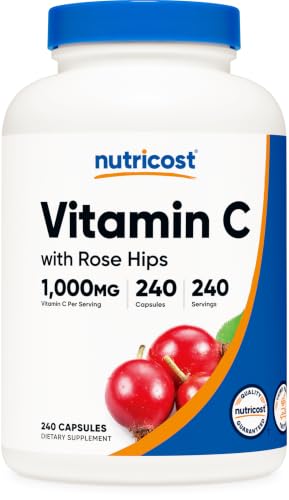
Nutricost gives 1,000 mg of ascorbic acid plus 25 mg of rose hip powder per capsule, at the lowest cost per 1,000 mg capsule on our list. It’s a large bottle for people who take vitamin C every day.
Label Reality Check
- Active ingredient + form
- vitamin C as ascorbic acid; rose hip powder
- Dose per serving
- 1 capsule = 1,000 mg vitamin C, 25 mg rose hips
- Dose vs. research
- Well above the RDA; less than half is absorbed at doses above 1 g1
- % DV / Upper Limit
- 1,111% DV; half the 2,000 mg upper limit1
- Purity testing
- Not stated
- Other ingredients
- gelatin capsule, magnesium stearate (vegetable source), silica
- Additives
- Clean
- Allergens & diet
- contains gelatin, so not vegetarian; gluten-free
- Safety flags
- Daily use of 1,000 mg was linked to more kidney stones in men4
Clinical Relevance
The 25 mg of rose hips adds very little vitamin C; the 1,000 mg comes from ascorbic acid. It’s a good value for 1,000 mg a day, with the same absorption limits as any high dose1.
Strengths
- Lowest cost per 1,000 mg capsule
- 240 servings per bottle
- Short ingredient list
Limitations
- Gelatin capsule
- Testing lab not named
- Capsule is slightly larger than average
Practical Details
Take 1 capsule a day with food. Store the bottle closed in a cool, dry place.
Best For / Not For
Best forbudget-minded adults who want 1,000 mg a day.
Not forvegetarians, or men with a history of kidney stones.
Buyer Experience
Buyers most often say the capsules are easy to swallow and easy on the stomach, and many have taken them daily for years without problems. They value the price, the large bottle and having rose hips included, and many say it supports their immune system through cold season. Buyers also mention that it has no aftertaste and usually arrives with a good expiration date, which matters for a bottle that lasts eight months.
Capsule size divides buyers: a large minority find it bigger than most. About a quarter of those who comment on digestion report some stomach upset, and some notice a slight taste.
vs. Sports Research
Choose Nutricost for the lowest cost. Choose Sports Research for a vegan capsule.
Nutritionist’s Note
If 1,000 mg feels like too much, you can open a capsule and take half, mixed into juice or yogurt.
Verdict: The best-value 1,000 mg vitamin C capsule for daily use.
#5Best Plant-Based
5. NATURELO Vitamin C 500

BFN Score8.7/10
$$$Mid-range180 servings (180 capsules)1 capsule per serving
Strongest atDose & safetyWeakest atQuality & trust
NATURELO gives 500 mg of vitamin C from L-ascorbate and organic acerola cherry extract, with 45 mg of citrus bioflavonoids. It’s a vegan option for people who want some of their vitamin C from fruit.
Label Reality Check
- Active ingredient + form
- vitamin C from L-ascorbate and organic acerola cherry extract; citrus bioflavonoids (bitter orange)
- Dose per serving
- 1 capsule = 500 mg vitamin C, 45 mg citrus bioflavonoids
- Dose vs. research
- Well above the RDA; the acerola share isn’t stated
- % DV / Upper Limit
- 556% DV; a quarter of the 2,000 mg upper limit1
- Purity testing
- Not stated
- Other ingredients
- organic acacia gum, hypromellose (vegetarian capsule), organic rice flour
- Additives
- Clean
- Allergens & diet
- vegan
- Safety flags
- Ask first if you have hemochromatosis
Clinical Relevance
Vitamin C from fruit and synthetic vitamin C are the same molecule and are absorbed equally well6. Acerola is a matter of preference rather than better absorption.
Strengths
- Vegan capsule with acerola
- Well-absorbed 500 mg dose
- Short, plant-based ingredient list
Limitations
- Higher cost per day than synthetic 500 mg options
- The label doesn’t say how much comes from acerola
- Some buyers found broken capsules in the bottle
Practical Details
Take 1 capsule a day with food. Buyers who take iron often take it at the same time.
Best For / Not For
Best forpeople who prefer vitamin C partly from whole fruit in a vegan capsule.
Not foranyone looking for the lowest cost.
Buyer Experience
Buyers rate the quality very highly and often mention the organic acerola cherries and clean ingredient list. Many take it with iron and say it pairs well, and others say it keeps them healthy through winter. Buyers also find it easy to swallow and gentle on the stomach, with no odd taste, and a few with food allergies value the simple formula. Many have reordered several bottles and like the brand’s other products too.
Some buyers feel it costs more than it should, and a few found the capsules too large. Several mention that some capsules arrived broken, with powder in the bottle.
vs. Thorne
Choose NATURELO for a vegan, fruit-based formula. Choose Thorne for NSF certification.
Nutritionist’s Note
Taking vitamin C with plant-based meals helps your body absorb more iron from those foods1.
Verdict: The best pick for vitamin C partly from fruit in a vegan capsule.
#6Best Powder
6. Micro Ingredients Vitamin C Powder

BFN Score8.7/10
$$$Budgetabout 1,000 servings (1 kg)1,000 mg per serving
Strongest atPurity & additivesWeakest atDose & safety
Micro Ingredients sells pure ascorbic acid powder with nothing added, at the lowest cost per gram on our list. Powder lets you take a small dose or split a larger one.
Label Reality Check
- Active ingredient + form
- vitamin C as ascorbic acid powder
- Dose per serving
- 1,000 mg (2 small scoops of 1/8 teaspoon each, per label)
- Dose vs. research
- Flexible; smaller amounts are absorbed better1
- % DV / Upper Limit
- 1,111% DV per serving; easy to exceed the 2,000 mg limit with a heaped spoon1
- Purity testing
- “Third-party lab tested” (brand claim, lab not named)
- Other ingredients
- none
- Additives
- Clean
- Allergens & diet
- vegan; gluten-free and non-GMO (brand claim)
- Safety flags
- Easy to take too much; high doses can cause diarrhea and cramps1
Clinical Relevance
Powder lets you take 250–500 mg twice a day, which is absorbed better than one large dose1. The trade-off is that measuring by eye can easily push you past the upper limit.
Strengths
- Lowest cost per gram
- No other ingredients
- Flexible dosing
Limitations
- Very sour taste
- Needs careful measuring
- Some lots arrived as crystals that dissolved slowly
Practical Details
Use the included scoop, not a kitchen spoon. Dissolve in water or juice and drink it right away; rinse your mouth after, as acidic drinks can wear tooth enamel.
Best For / Not For
Best forpeople who want to mix vitamin C into drinks or adjust their dose.
Not foranyone who wants a no-measuring routine, or households with children who could reach the bag.
Buyer Experience
Buyers praise the purity and say the powder dissolves quickly in water or juice, with no fillers. Many value how long the bag lasts compared with buying capsules, and some mix it into juices they already drink to hide the tartness. Buyers like being able to give smaller amounts to family members, find it easy to take once they’re used to it, and most report no side effects at their usual dose.
Taste is the main split: about half of buyers who mention it find it very sour. A few report that a later bag had coarser crystals that dissolved slowly, and one received a bag split at the seam.
vs. Sports Research
Choose Micro Ingredients for the lowest cost and flexible dosing. Choose Sports Research for a measured dose in a capsule.
Nutritionist’s Note
Ascorbic acid is acidic; drinking it through a straw and rinsing with water afterward helps protect your teeth.
Verdict: The best-value vitamin C if you’re happy to measure a sour powder.
#7Best Liposomal
7. Dr. Mercola Liposomal Vitamin C

BFN Score8.2/10
$$$Premium90 servings (180 capsules)2 capsules per serving
Strongest atDose & safetyWeakest atValue & practicality
Dr. Mercola wraps 1,000 mg of vitamin C in sunflower lecithin, a liposomal form meant to improve absorption. It’s the best-known liposomal capsule, though the research behind liposomal vitamin C is small.
Label Reality Check
- Active ingredient + form
- vitamin C as ascorbic acid in a liposomal (sunflower lecithin) carrier
- Dose per serving
- 2 capsules = 1,000 mg
- Dose vs. research
- Liposomal vitamin C raised blood levels more than regular vitamin C in one small study at 4 g doses5
- % DV / Upper Limit
- 1,111% DV; half the 2,000 mg upper limit1
- Purity testing
- Not stated
- Other ingredients
- sunflower lecithin, medium-chain triglycerides, hypromellose (capsule), paprika oleoresin (color), sunflower oil
- Additives
- Note – paprika oleoresin, a natural color with no nutritional role
- Allergens & diet
- vegan capsule; soy-free (sunflower lecithin)
- Safety flags
- Daily use of 1,000 mg was linked to more kidney stones in men4
Clinical Relevance
In a small study, liposomal vitamin C raised blood levels more than the same dose of regular vitamin C, though far less than IV vitamin C5. Whether that matters for healthy people taking 1,000 mg a day hasn’t been shown.
Strengths
- Sunflower lecithin, so no soy
- Buyers say it’s easy on the stomach
- 90 servings per bottle
Limitations
- Highest cost per day on our list
- Two capsules per serving
- Many buyers question whether a dry capsule can be truly liposomal
Practical Details
Take 2 capsules a day, together or split between meals. Keep the bottle tightly closed.
Best For / Not For
Best forpeople who get stomach upset from regular vitamin C and want to try a liposomal form.
Not forbuyers focused on cost, or anyone expecting clear proof of extra benefit.
Buyer Experience
Many buyers say this works better for them than regular vitamin C and is easier on the stomach, and some have used it for years as soon as they feel a cold coming on. Buyers find the capsules easy to swallow, say it doesn’t cause digestive issues even at higher amounts, and like that one bottle lasts three months. Some first tried it on a practitioner’s recommendation.
Price and ingredients are the main concerns: many buyers feel it’s overpriced, and about half of those who discuss ingredients question whether a dry capsule can be truly liposomal. A few received bottles with damaged caps.
vs. NOW C-500
Choose Dr. Mercola if you want to try liposomal vitamin C. Choose NOW for a gentle buffered form at a much lower cost.
Nutritionist’s Note
For more liposomal options, including liquids, see our guide to the best liposomal vitamin C supplements.
Verdict: A popular liposomal option, best for people who don’t tolerate regular vitamin C well.
Products We Considered but Didn’t Include
Metagenics Ultra Potent-C 1000. A buffered complex, but each tablet adds 70 mg of niacin, twice the 35 mg upper limit for supplemental niacin.
Micro Ingredients Liposomal Vitamin C 2,500 mg. The label serving of four capsules gives 2,500 mg a day, above the 2,000 mg upper limit1.
Garden of Life Vitamin Code Raw Vitamin C. A whole-food blend with probiotics and enzymes that doesn’t list the amount of each fruit or vegetable.
Integrative Therapeutics Buffered Vitamin C. Sold as buffered, but each 1,000 mg capsule has only 20 mg of calcium carbonate and 12 mg of magnesium carbonate, so it’s mostly ascorbic acid.
Evidence Scorecard
| Use | What it’s studied for | Evidence level | Notes |
|---|---|---|---|
| Preventing deficiency | Scurvy, low intake | Strong | The RDA prevents deficiency; most people meet it from food1 |
| Colds (general population) | Fewer colds | Not shown | Regular use didn’t lower how often people caught colds3 |
| Colds (regular use) | Shorter colds | Moderate | About 8% shorter in adults and 14% in children3 |
| Colds (heavy physical stress) | Fewer colds | Moderate | About half the risk in marathon runners, skiers and soldiers3 |
| Iron absorption | Absorbing iron from plant foods | Moderate | Helps absorb iron from plant foods1; adding it to iron tablets didn’t raise hemoglobin more in one trial7 |
The vitamin C in our top picks has strong support for preventing deficiency and moderate support for slightly shorter colds. It isn’t a treatment for infections and shouldn’t replace medical care.
How to Take Vitamin C for Best Results
| Life stage | RDA | Upper Limit (UL) |
|---|---|---|
| Men 19+ | 90 mg | 2,000 mg |
| Women 19+ | 75 mg | 2,000 mg |
| Pregnancy | 85 mg | 2,000 mg |
| Breastfeeding | 120 mg | 2,000 mg |
| Smokers | Add 35 mg | 2,000 mg |
| Teens 14–18 | 65–75 mg | 1,800 mg |
| Children 9–13 | 45 mg | 1,200 mg |
Source: NIH Office of Dietary Supplements2. The UL includes vitamin C from food and supplements.
- Smaller doses absorb better. About 70–90% is absorbed at intakes of 30–180 mg, but less than half above 1 g1.
- Split larger amounts. If you take 1,000 mg, two 500 mg doses are absorbed better than one.
- Take it with food if it bothers your stomach, or switch to a buffered form.
- Pair it with iron-rich plant foods to absorb more iron from them1. If you take iron tablets, see our guide to iron supplements for low ferritin.
What to Expect and When
If you take vitamin C to fill a gap in your diet, blood levels rise within days to weeks. If you take it for colds, any benefit is a slightly shorter cold over a season of regular use, not instant protection3.
If you have signs of deficiency, such as bleeding gums or poor wound healing, see your doctor; these usually improve within weeks once intake is corrected.
Safety, Side Effects & Drug Interactions
Too much vitamin C can cause diarrhea, nausea and stomach cramps2. These effects usually go away when you lower the dose. Stay at or below 2,000 mg a day from all sources unless your doctor advises otherwise1.
| Medication or condition | Possible interaction | What to do |
|---|---|---|
| Hemochromatosis | High doses could worsen iron overload2 | Avoid supplements unless your doctor approves |
| History of kidney stones | Daily supplements linked to more stones in men4 | Ask your doctor; food sources are safer |
| Chemotherapy or radiation | Effect on treatment is unclear2 | Ask your oncologist before taking any |
| Statins with niacin | Vitamin C with other antioxidants reduced their benefit in one study2 | Ask your doctor |
| Kidney disease | Higher oxalate load | Ask your doctor before taking high doses |
Food First: Where Else to Get Vitamin C
| Food | Serving | Vitamin C |
|---|---|---|
| Red pepper, raw | 1/2 cup | 95 mg |
| Orange juice | 3/4 cup | 93 mg |
| Orange | 1 medium | 70 mg |
| Kiwifruit | 1 medium | 64 mg |
| Green pepper, raw | 1/2 cup | 60 mg |
| Broccoli, cooked | 1/2 cup | 51 mg |
| Strawberries | 1/2 cup | 49 mg |
| Brussels sprouts, cooked | 1/2 cup | 48 mg |
Source: NIH Office of Dietary Supplements, using USDA FoodData Central1.
An orange and a serving of broccoli together give more than the RDA for most adults.
How to Choose a Vitamin C Supplement
Form and Absorption
Ascorbic acid is the standard form and is absorbed as well as vitamin C from fruit6. Calcium ascorbate (buffered) is less acidic. Liposomal forms raised blood levels more in one small study, but cost much more5.
Dose and % DV
For most people, 250–500 mg a day is plenty. More than 1,000 mg is absorbed poorly and adds to kidney stone risk in men14.
Purity Testing
Look for NSF or USP certification. “Third-party tested” without a lab name tells you less.
Additives and Allergens
Cellulose capsules, rice flour, silica and magnesium stearate are normal and aren’t a concern. Gelatin capsules aren’t vegetarian. Some liposomal products add natural colors that serve no nutritional purpose.
Pill Burden and Format
Most vitamin C comes as one capsule a day. Powders and liquids suit people who can’t swallow pills or want to adjust the dose.
Cost per Effective Dose
Compare cost per 500 mg, not per bottle. A large bottle of 500 mg capsules often costs less per day than a premium 1,000 mg product you’d absorb less of.
Label Red Flags
- Daily doses above 2,000 mg
- Complex formulas with other nutrients above their upper limits
- “Buffered” claims with only a trace of minerals
- Claims that vitamin C cures or prevents infections
Important: These supplements are not intended to diagnose, treat, cure, or prevent any disease. Results vary by individual. If you have a health condition or take medications, check with your doctor before adding any new supplement to your routine.
Frequently Asked Questions
What is the best vitamin C supplement?
Thorne Vitamin C with Flavonoids is our top pick: 500 mg per capsule, NSF Certified for Sport. For a gentle buffered form at a low cost, choose NOW C-500 Calcium Ascorbate.
Is 1,000 mg of vitamin C a day too much?
What is the best form of vitamin C?
Does vitamin C help with iron absorption?
Does vitamin C prevent colds?
Final Verdict
Thorne Vitamin C with Flavonoids is the best vitamin C supplement for most people: 500 mg per capsule, NSF certified.
If ascorbic acid bothers your stomach, choose NOW C-500 Calcium Ascorbate. For 1,000 mg in one plant capsule, choose Sports Research, and for the lowest cost, Micro Ingredients powder.
If you have hemochromatosis, kidney stones or are having cancer treatment, talk to your doctor before taking vitamin C supplements.
Sources & History
References
- Vitamin C: Fact Sheet for Health Professionals — NIH Office of Dietary Supplements
- Vitamin C: Fact Sheet for Consumers — NIH Office of Dietary Supplements
- Vitamin C for Preventing and Treating the Common Cold — Cochrane Database of Systematic Reviews, 2013
- Ascorbic Acid Supplements and Kidney Stone Incidence Among Men: A Prospective Study — JAMA Internal Medicine, 2013
- Liposomal-Encapsulated Ascorbic Acid: Influence on Vitamin C Bioavailability and Capacity to Protect Against Ischemia–Reperfusion Injury — Nutrition and Metabolic Insights, 2016
- Synthetic or Food-Derived Vitamin C—Are They Equally Bioavailable? — Nutrients, 2013
- The Efficacy and Safety of Vitamin C for Iron Supplementation in Adult Patients With Iron Deficiency Anemia: A Randomized Clinical Trial — JAMA Network Open, 2020
Update history
- Rebuilt as our main vitamin C guide with BFN Score v3: compared 17 vitamin C labels and ranked seven by dose, form, testing, other ingredients, safety flags, cost per day and buyer feedback; added dose-vs-absorption and upper limit tables, cold and kidney stone evidence, and a drug interaction table. January 5, 2026 – Original article published.