We may earn a commission when you buy through our links, at no extra cost to you. As an Amazon Associate we earn from qualifying purchases. How we make money
At a Glance
- What it is Niacinamide (nicotinamide) is a form of vitamin B3 used in skin creams and taken as a supplement3.
- Taken by mouth The best evidence is for preventing new non-melanoma skin cancers in people who’ve had several, at 500 mg twice a day1.
- Applied to skin Small trials found 2% to 5% niacinamide creams reduced dark spots, and 4% gel worked about as well as clindamycin for acne457.
- The catch Most skin-appearance benefits come from creams, not pills. We didn’t find placebo-controlled trials of oral niacinamide for wrinkles, dark spots or acne.
- Top pick Micro Ingredients Niacinamide – the #1 pick in our guide to the best niacinamide supplements: one 2-capsule serving gives 1,000 mg, the daily amount used in the skin cancer trial1.
The Short Answer: Niacinamide’s benefits depend on how you use it. As a supplement, its strongest result is a 23% drop in new non-melanoma skin cancers in high-risk people taking 500 mg twice a day1. It didn’t help organ transplant recipients2.
On this page
On the skin, creams with 2% to 5% niacinamide improved dark spots, red blotchiness and fine lines in small trials, and 4% gel helped inflammatory acne457. Pills haven’t been tested the same way for these. If you want brighter, smoother skin, a cream is the better-studied choice. If your dermatologist recommends it for skin cancer prevention, see our guide to the best niacinamide supplements.
What Is Niacinamide?
Niacinamide, also called nicotinamide, is one of the two main forms of vitamin B3. The other is nicotinic acid, usually called niacin. Flushing happens mainly with high doses of nicotinic acid, not nicotinamide3. Adults need 14 to 16 mg of niacin a day3. The skin cancer trials used 500 mg twice a day1, while the skin cream trials used 2% to 5% niacinamide45.
Taking vs Applying Niacinamide
| Use | Form studied | What the research shows |
|---|---|---|
| Preventing non-melanoma skin cancer | Oral, 500 mg twice daily | 23% fewer new cancers in high-risk adults1; no effect after organ transplant2 |
| Actinic keratoses | Oral, 500 mg twice daily | Up to 20% fewer1 |
| Dark spots and uneven tone | Topical, 2% to 5% | Less hyperpigmentation than plain moisturizer45 |
| Melasma | Topical, 4% | Close to hydroquinone, fewer side effects, small trial9 |
| Acne | Topical, 4% gel | Similar to clindamycin gel7; evidence low quality8 |
| Fine lines and texture | Topical, 5% | Better than plain moisturizer in 50 women5 |
| Skin barrier and dryness | Topical | Raised skin ceramides and reduced water loss in dry skin6 |
| Acne and rosacea | Oral, with zinc | One uncontrolled study11 |
Niacinamide Benefits for Skin
Skin Cancer Prevention (Oral)
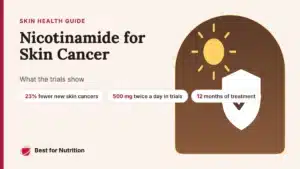
In the ONTRAC trial, 386 people who’d had at least two non-melanoma skin cancers took 500 mg of nicotinamide or placebo twice a day for a year. The nicotinamide group had 23% fewer new skin cancers1. The benefit didn’t last after they stopped1. In organ transplant recipients, the same dose had no effect2. For the full evidence, see our guide to nicotinamide for skin cancer.
Dark Spots and Melasma (Topical)
In lab models, niacinamide blocked the transfer of pigment from pigment cells to skin cells by 35% to 68%4. In two clinical tests in Japanese women, one with 18 people using a 5% niacinamide moisturizer and one with 120 people with tanned skin using 2% niacinamide, niacinamide reduced hyperpigmentation and increased skin lightness compared with a plain base after 4 weeks4.
For melasma, an 8-week split-face trial in 27 patients compared 4% niacinamide with 4% hydroquinone. Both improved pigmentation, with no significant difference in color measurements9. A 2019 review of melasma trials gave its strongest recommendations to other treatments, such as tranexamic acid and triple combination creams10.
Fine Lines, Redness and Yellowing (Topical)
In a 12-week split-face trial of 50 women aged 40 to 60, a 5% niacinamide moisturizer improved fine lines and wrinkles, dark spots, texture, red blotchiness and yellowing compared with the same moisturizer without niacinamide5.
Skin Barrier (Topical)
Niacinamide increased the production of ceramides, fats that help skin hold water, in skin cells. Applied to dry skin, it raised ceramide levels and reduced water loss6.
Acne (Topical and Oral)
In an 8-week trial of 76 people with moderate inflammatory acne, 82% improved with 4% nicotinamide gel and 68% with 1% clindamycin gel, a difference that wasn’t significant7. A 2020 Cochrane review rated the evidence for nicotinamide in acne as low quality and found no clear difference in side effects vs clindamycin8.
For pills, the main study gave 198 people with acne or rosacea a tablet with 750 mg nicotinamide plus zinc, copper and folic acid. Overall, 79% said their skin looked moderately or much better, but there was no control group11.
Other Uses
A 2020 review describes oral nicotinamide as an option doctors use for actinic keratoses, basal and squamous cell cancers and bullous pemphigoid, a blistering skin disease12. These uses need a doctor’s care.
Our Top Niacinamide Pick
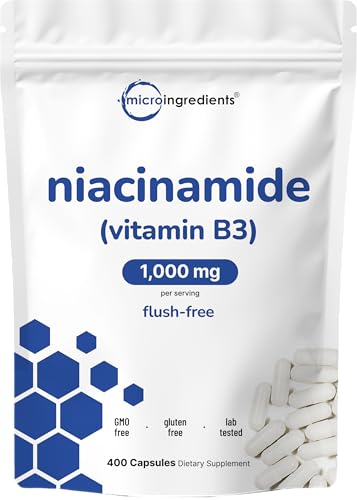
500 mg per capsule1,000 mg per servingTrial daily amount
The #1 pick in our guide to the best niacinamide supplements. One 2-capsule serving gives 1,000 mg of niacinamide, the daily amount used in the skin cancer trials, at the lowest cost per serving of the products we compared. The product itself hasn’t been tested in its own trial.
Who Might Benefit From Niacinamide Supplements
- People with several past non-melanoma skin cancers, after talking with a dermatologist1
- Probably not organ transplant recipients, based on a placebo-controlled trial2
- Probably not people seeking smoother or brighter skin, since the evidence for those benefits comes from creams45
The 500 mg doses in supplements are far above the 35 mg upper limit for niacin from supplements3. For safety details, see our guide to niacinamide side effects.
Final Verdict
Niacinamide works in two different ways. Taken by mouth at 500 mg twice a day, it lowered new non-melanoma skin cancers in people at high risk1. Applied as a 2% to 5% cream or gel, it improved dark spots, fine lines and acne in small trials457. Don’t expect a pill to do what the creams were tested for.
If your dermatologist recommends oral niacinamide, consider Micro Ingredients Niacinamide, which gives the trial’s 1,000 mg daily amount in one 2-capsule serving. Compare all picks in our guide to the best niacinamide supplements.
Important: This guide is for general information and isn’t medical advice. Talk to your doctor before taking high-dose niacinamide, especially if you have liver disease or take other medicines.
Frequently Asked Questions
What does niacinamide do for your skin?
Is it better to take niacinamide or put it on your skin?
Does oral niacinamide help acne?
Does niacinamide lighten skin?
Topical niacinamide reduced hyperpigmentation and lightened tanned skin in trials4.
Is niacinamide the same as niacin?
No. Both are vitamin B3, but niacin (nicotinic acid) is more likely to cause flushing3. See our guide to niacinamide vs niacin.
How long does niacinamide take to work?
Sources & History
References
- A Phase 3 Randomized Trial of Nicotinamide for Skin-Cancer Chemoprevention — New England Journal of Medicine, 2015
- Nicotinamide for Skin-Cancer Chemoprevention in Transplant Recipients — New England Journal of Medicine, 2023
- Niacin – Vitamin B3 — The Nutrition Source, Harvard T.H. Chan School of Public Health
- The Effect of Niacinamide on Reducing Cutaneous Pigmentation and Suppression of Melanosome Transfer — British Journal of Dermatology, 2002
- Topical Niacinamide Reduces Yellowing, Wrinkling, Red Blotchiness, and Hyperpigmented Spots in Aging Facial Skin — International Journal of Cosmetic Science, 2004
- Nicotinamide Increases Biosynthesis of Ceramides as Well as Other Stratum Corneum Lipids to Improve the Epidermal Permeability Barrier — British Journal of Dermatology, 2000
- Topical Nicotinamide Compared With Clindamycin Gel in the Treatment of Inflammatory Acne Vulgaris — International Journal of Dermatology, 1995
- Topical Azelaic Acid, Salicylic Acid, Nicotinamide, Sulphur, Zinc and Fruit Acid (Alpha-Hydroxy Acid) for Acne — Cochrane Database of Systematic Reviews, 2020
- A Double-Blind, Randomized Clinical Trial of Niacinamide 4% Versus Hydroquinone 4% in the Treatment of Melasma — Dermatology Research and Practice, 2011
- Topical Treatments for Melasma: A Systematic Review of Randomized Controlled Trials — Journal of Drugs in Dermatology, 2019
- The Nicomide Improvement in Clinical Outcomes Study (NICOS): Results of an 8-Week Trial — Cutis, 2006
- Nicotinamide: An Update and Review of Safety & Differences From Niacin — Skin Therapy Letter, 2020
Update history
- New guide covering niacinamide benefits taken by mouth and applied to skin, based on the ONTRAC and ONTRANS trials, topical niacinamide trials for pigmentation, aging skin, barrier function, melasma and acne, and a 2020 Cochrane review.